The higher education landscape in India is experiencing a monumental transformation with the introduction of the UGC Bill 2026, officially titled the Promotion of Equity in Higher Education Institutions Regulations, 2026 (also frequently referenced as the UGC Act 2026). Established to overhaul and replace the outdated 2012 framework, these new guidelines trace their roots back to crucial directives issued by the Supreme Court of India following notable discrimination cases in 2025, including those concerning Rohith Vemula and Payal Tadvi. Formally implemented on 13th January 2026, this regulatory shift aims to robustly reinforce institutional accountability across the University Grants Commission (established in 1956) network.
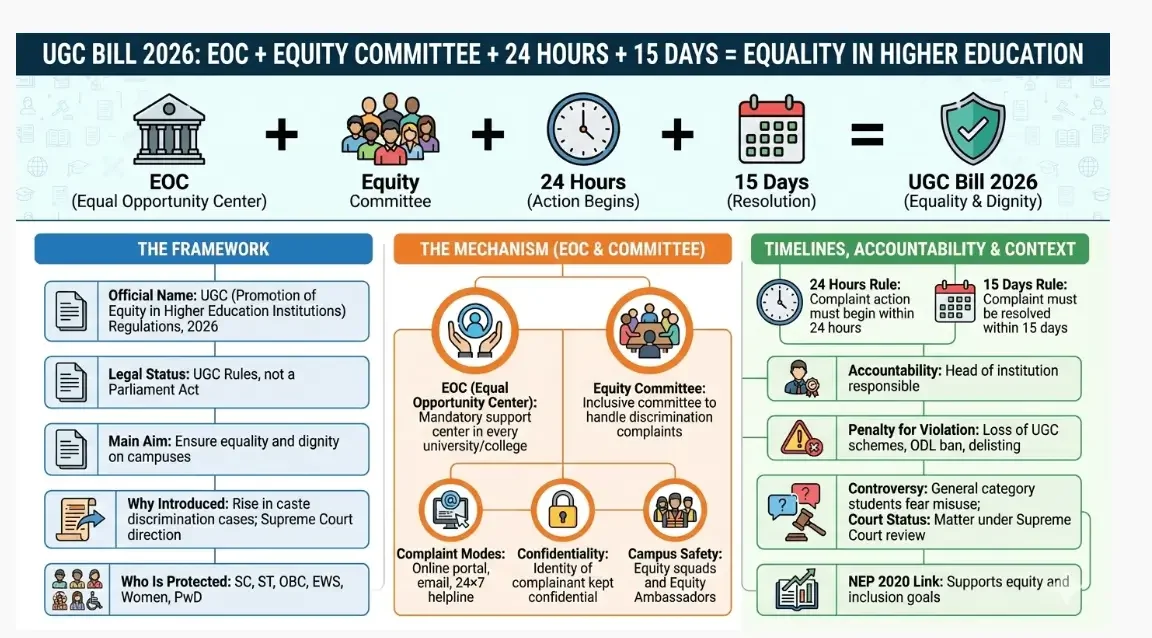
Core Focus Areas of UGC Act 2026
The updated regulatory structure shifts focus toward establishing a safer, more inclusive environment across every university and college. Institutions are now required to pivot their focus onto specific structural priorities:
- Prevent caste-based, gender-based, religious, and social discrimination
- Guarantee equal opportunities for all students
- Implement effective monitoring, grievance redressal, and accountability systems
- Enhance institutional governance and compliance
Top 5 Major Changes in the 2026 Framework
To fully appreciate how drastically governance has evolved, stakeholders must review the core modifications introduced in the 2026 regulations:
- Formal Inclusion of OBCs: Explicit protection of Other Backward Classes (OBCs) within the anti-discrimination framework
- Mandatory Equal Opportunity Centres (EOC): Compulsory establishment of dedicated Equal Opportunity Centres in all universities and colleges
- The Equity Committee & Squads: Formation of a 10-member Equity Committee and mobile Equity Squads visiting vulnerable campus spots
- 24/7 Equity Helpline: Maintenance of a round-the-clock helpline, online reporting portal, and appointment of Equity Ambassadors
- Strict Time-Bound Redressal: Clear timeframes for grievance resolution (24 hours for committee meeting, 15 days for inquiry report, 30 days for appeal)
Protected groups under the newly implemented framework notably include SC, ST, OBC, EWS, PwBD, and Women. To ensure robust administration, institutions must assemble a 10-member Equity Committee chaired by the institution's head, requiring at least 50% representation from SC, ST, OBC, PwBD, or Women categories.
Overview of Regulations and Comparative Matrix
The following data tables outline the structured features and institutional comparison brought forth by the legislation:
| Features | Details |
|---|---|
| Regulation Name | Promotion of Equity in HEIs Regulations 2026 |
| Implementation | 13th January 2026 |
| Protected Groups | SC, ST, OBC, EWS, PwBD, and Women. |
| Core Focus | Equity, inclusion, grievance redressal |
| New Bodies | EOC, Equity Committee, Equity Squads |
| Coverage | All universities & colleges |
| Penalty | Funding cut, derecognition |
| Metric | 2012 Guidelines | 2026 Regulations |
|---|---|---|
| Definition of Discrimination | Vague | Clearly defined |
| Complaint Timeline | Not fixed | 24 hrs + 15 days |
| Accountability | Limited | Direct institutional liability |
| Monitoring | Internal | National-level oversight |
| Enforcement | Weak | Strict penalties |
Penalties for Non-Compliance
To enforce strict adherence across educational institutions, the regulation imposes heavy legal and financial consequences for non-compliance:
- Withdraw Grants: Stop all central funding and schemes
- Revoke Degrees: Bar the institution from awarding degrees
- De-recognition: Remove the institution from the official UGC-recognised list
- Online Programs: Suspend permission for distance and online learning
Main Reasons for the UGC Act 2026 Controversy
Despite sweeping provisions for social justice, the bill has encountered significant public and legal pushback. You can stay updated on ongoing legal challenges by checking UGC Protest Live Updates: Supreme Court Stays on New Regulations. The key friction points include:
- Definition of Discrimination: Critics argue the definition of 'indirect discrimination' is unclear, leading to potential misuse
- Unbalanced Representation: Lack of explicit representation for the general category in the Equity Committee
- Legal Challenge: Student groups challenging caste-based protections in the Supreme Court
Additional Documentation & Resources
For those seeking deep technical and legal insights into the bill, reference texts are publicly archived. You can review the complete framework documentation via the UGC Bill 2026 (Hindi) Full Details Document.
Next steps for candidates, students, and academic administrators involve regularly monitoring institutional compliance announcements, ensuring that grievance cells are properly communicated, and preparing for ongoing administrative audits.
Frequently Asked Questions (FAQs)
Recommended Reads
- UGC Bill 2026: Promotion of Equity in Higher Education Regulations
- UGC NET June 2026 Admit Card Released: Download Hall Ticket & Exam Schedule
- UGC NET June 2026: Exam Dates, Schedule, Eligibility & Pattern
- UGC NET June 2026 Application Deadline Extended to May 23 | Apply Online Now
- UGC NET June 2026: Exam Dates, Eligibility & Essential Preparation Guide
- UGC NET City Intimation Slip 2026 Released: Direct Download Link & Exam Dates
Negative Marking & Net Score Calculator
Calculate your exact post-answer-key net marks after deducting 1/3rd or 1/4th negative penalty across SSC, UPSC, and State exams.
Never miss another exam update!
Get the fastest exam results, recruitment news, and educational guides delivered directly to your phone.