Geometry forms the foundation of spatial understanding, and at the heart of geometric study lies the triangle. A triangle is a fundamental polygon defined by three sides and three interior angles. Across any variety of triangle, a core rule applies: the sum of all interior angles within any triangle is always 180 degrees, a principle famously known as the angle sum property. To better understand these shapes, mathematicians group them into various categories.
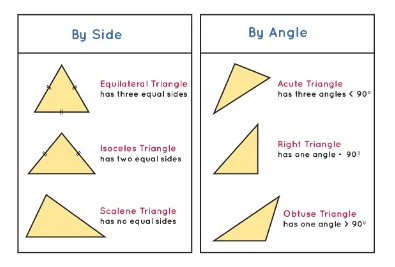
Triangles are classified into 6 primary types based on side lengths and angle measurements. Whether you are studying basic geometry or exploring advanced mathematical properties, recognizing how these shapes are categorized is essential.
Classification Based on Side Lengths
When categorized by the length of their sides, triangles fall into three distinct groupings:
| Types of Triangles Based on Sides |
|---|
| 1. Equilateral Triangle |
| 2. Isosceles Triangle |
| 3. Scalene Triangle |
- 1. Equilateral Triangle
- 2. Isosceles Triangle
- 3. Scalene Triangle
1. Equilateral Triangle
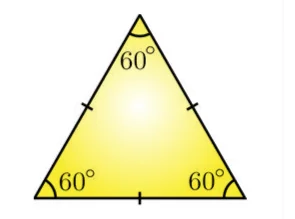
An equilateral triangle has equal length on all three sides and each interior angle is exactly 60 degrees. Because all of its angles are equal, an equilateral triangle is also referred to as an equiangular triangle. Furthermore, equilateral and isosceles triangles exhibit reflection symmetry.
2. Isosceles Triangle
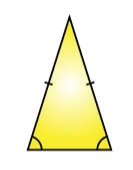
An isosceles triangle has two equal sides and the angles opposite the equal sides are also equal (2 congruent sides and 2 congruent angles). Like their equilateral counterparts, these shapes also exhibit reflection symmetry.
3. Scalene Triangle
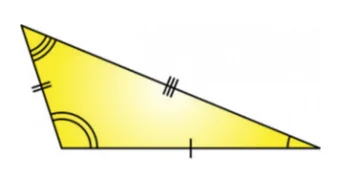
A scalene triangle has three sides of unequal lengths with no equal sides and no equal interior angles.
Classification Based on Interior Angles
Triangles can alternatively be categorized by evaluating the measurement of their interior angles:
| Types of Triangles Based on Angles |
|---|
| 1. Acute-angled Triangle |
| 2. Obtuse-angled Triangle |
| 3. Right-angled Triangle |
- 1. Acute-angled Triangle
- 2. Obtuse-angled Triangle
- 3. Right-angled Triangle
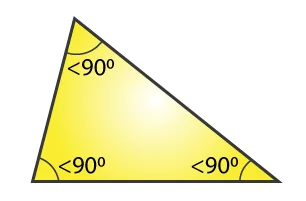
1. Acute-angled Triangle
An acute-angled triangle features three acute interior angles, with each individual angle measuring less than 90 degrees.
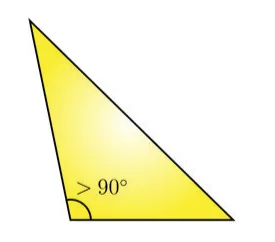
2. Obtuse-angled Triangle
An obtuse-angled triangle contains one obtuse angle that measures greater than 90 degrees.
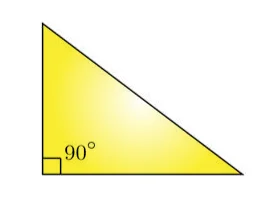
3. Right-angled Triangle
A right-angled triangle contains one right angle measuring exactly 90 degrees. In this configuration, the side opposite the 90-degree angle is the longest side, referred to as the hypotenuse.
Combined Classifications
It is also possible for categories to overlap. Combined classifications exist, such as a right isosceles triangle, which possesses two equal sides, two equal angles, and one 90-degree angle. By blending side length rules with angle measurements, geometry provides a precise framework for identifying every unique triangle.
Frequently Asked Questions (FAQs)
Recommended Reads
- Understanding Computer Software: System & Application Types Explained
- Understanding Types of Computers: A Comprehensive Classification Guide
- Understanding Environmental Pollution: Causes, Effects, and Mitigation Strategies
- The Ultimate Guide to Operating Systems: Types, Features & Evolution
- Mastering English Grammar: Sentence Types & Structure Explained
- Understanding Writs Under the Indian Constitution: A Comprehensive Legal Guide
Exam Photo & Signature Resizer (20KB - 50KB)
Resize passport photo & signature to 20-50KB with Name & Date of Photo (DOP) strip or combine them in 1-click.
Never miss another exam update!
Get the fastest exam results, recruitment news, and educational guides delivered directly to your phone.