Ratio and Proportion Formula: Ratios and proportions are fundamental mathematical concepts based on fractional relationships. A ratio expresses a relationship between two numbers as a : b, while a proportion confirms that two ratios are equivalent. In this context, a and b represent integers. Mastering these topics is essential for solving complex mathematical problems. In everyday life, we frequently use ratio and proportion in scenarios like financial transactions, comparing physical measurements, or scaling ingredients in cooking. This article provides a complete overview, including definitions, essential formulas, the key differences between the two, and step-by-step solved examples.
Ratio and Proportion
Students often find the distinction between ratio and proportion challenging. A ratio is a comparative analysis of two quantities expressed using division. Conversely, a proportion identifies when two distinct ratios share the same value. A ratio can be written in formats such as x : y or x / y, read as "x is to y." A proportion, however, is a mathematical equation asserting the equality of two ratios. Proportions are expressed as x : y : : p : q, read as "x is to y as p is to q," where the denominators y and q must be non-zero.
Definition of Ratio
A Ratio is defined as the comparison of two parameters using a division operator between the first and second quantities. When x and y are quantities of the same type and units (where y ≠ 0), the quotient x/y represents the ratio. Ratios are typically represented by the colon symbol (:). Because the ratio x/y is a unitless value expressed as x : y, it functions as a fractional representation of one quantity relative to another. Note that quantities can only be compared via ratios if they share identical units.
Definition of Proportion
A Proportion is a mathematical statement asserting that two given ratios are equivalent. Essentially, proportion represents the equality of two fractional numbers or ratios. When two sets of quantities increase or decrease in tandem at the same rate, they are directly proportional. Proportions are denoted by the double-colon sign (: :) and are vital for calculating unknown variables.
Types of Proportion
Proportions are categorized into two primary types:
1. Direct Proportion
Direct proportion describes a linear relationship where two variables change in the same direction. If one increases, the other increases proportionally. Thus, direct proportion is expressed as a ∝ b. For instance, as a vehicle's speed increases, the distance covered in a set time also increases.
2. Inverse Proportion
Inverse proportion refers to an inverse relationship where one value increases as the other decreases. Therefore, inverse proportion is expressed as a ∝ 1/b. For example, the more liquid consumed from a container, the less remains within it.
Ratio and Proportion Formula
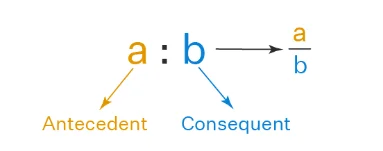
The Ratio Formula is expressed as x : y ⇒ x/y where
x = Antecedent or the first term
y = Consequent or the second term
For example, in the ratio 5 : 4, which is written as 5/4, the number 5 is the antecedent, and 4 is the consequent.

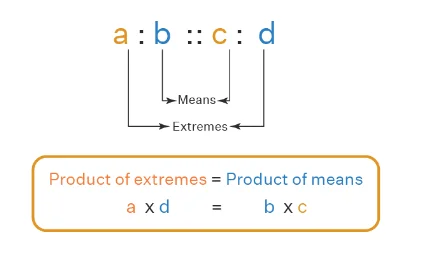
To express a proportion between two ratios, a : b and p : q, we write: a : b :: p : q ⟹ a/b = p/q
- The two numbers namely b and p are called the mean terms.
- The two numbers namely a and q are called the extreme terms.
- In a : b = p : q, the numbers or parameters of a and b should be of the same type with similar units, while p and q may be the separate ratios of parameters of the same type with similar units. For example, 6 meter : 17 meter = 35 kg : 22 kg
- In the concept of proportion, the product of the mean terms is equivalent to the product of the extreme terms. Hence we get b × p = a × q.
- For example, In the proportion of two ratios of 4 : 8 :: 5 : 10, we apply the formula of The Product of Mean Terms = The Product of Extreme Terms
For instance, 8 × 5 = 4 × 10 = 40.
- The proportion formula can be written in the form of a/b = c/d or a : b : : c : d.

Difference Between Ratio and Proportion
While often grouped together, ratio and proportion are distinct concepts. Understanding their specific roles is crucial for accurate calculation. Below is a comparison to help clarify the differences.
| Ratio | Proportion |
| It is employed in the comparison of different quantities having the same units. | It is employed in expressing a relationship between two ratios and both ratios can have different units. |
| A colon (:), slash (/) symbols are used to express a ratio. | The double colon (::) symbol is used to express a proportion. |
| It is described as an expression. | It is described as an equation. |
Key Notes on Ratio and Proportion
- Any quantities/ parameters having similar units can be compared by using the concept of ratio.
- Always 2 ratios are known to be in a proportion relation only when they are the same.
- For checking out the equality of two ratios and their status in proportion, you can also apply the method of cross-multiplication.
- When you multiply and divide each number of a ratio by a similar number, then the ratio always gives similar results.
- In the case of any 3 quantities, when the ratio between the 1st and the 2nd quantity is equivalent to the ratio between the 2nd and the 3rd quantity, then this equation is considered the continued proportion.
- Similarly, for any 4 quantities in a continued proportion equation, the ratio between the 1st and the 2nd quantity is equivalent to the ratio between the 3rd and the 4th quantity.
Ratio and Proportion Solved Examples
Question 1: In a class of 49 students, the ratio of students preferring Social Science to those preferring Science is 5:2. Determine the number of students for each subject.
Solution: Total number of students = 49
Let the number of Social Science students = 5x and
the number of Science students = 2x
Based on the problem, 5x + 2x = 49 ⟹ 7x = 49 ⟹ x = 7
Substituting x = 7 into our expressions,
we find the number of Social Science students = 5 × 7 = 35, and Science students = 2 × 7 = 14.
Therefore, 35 students prefer Social Science, and 14 students prefer Science.
Question 2: Determine if the ratios 7:8 and 4:3 are in proportion.
Solution: The given ratios are 7:8 and 4:3.
Converting to decimal form:
7:8 = 0.875 and 4:3 = 1.33
Since the values are not equal, 7:8 and 4:3 are not in proportion.
Question 3: Persons P and Q agree to split a shop's annual profit of Rs. 5,000 in a ratio of 6:5. How much does each person receive?
Solution: Total profit is divided in a 6:5 ratio.
Calculating the individual shares:
P = 5,000 × (6/11) = 2727.27
Q = 5,000 × (5/11) = 2272.72
Thus, the individual shares for P and Q are 2727.27 and 2272.72 respectively.
Question 4: If Sahil travels 15 km in 3 hours, how far will he travel in 7 hours?
Solution: Let the distance in 7 hours be z. As time increases, distance increases.
So, 3 : 7 = 15 : z
z = (15 × 7) / 3
z = 35 km
Sahil will travel 35 km in 7 hours.
Question 5: Find two numbers that sum to 99 and are in a ratio of 5:4.
Solution: Represent the numbers as 5x and 4x.
Their sum is given as 99.
5x + 4x = 99
9x = 99
x = 11
The numbers are:
5x = 5 × 11 = 55
4x = 4 × 11 = 44
The two numbers, 55 and 44, satisfy the conditions.
Ratio and Proportion: FAQs
Ans. A ratio compares two quantities of similar units, whereas a proportion relates two ratios.
Ans. The ratio formula for numbers x and y is x/y. The proportion formula for ratios a:b and c:d is a/b = c/d.
Ans. A ratio is a direct comparison; a proportion shows equality between two ratios.
Ans. Yes, they are linked. Ratios compare quantities, while proportions indicate that multiple ratios possess identical values.
Ans. Direct proportion occurs when variables change in the same direction. Inverse proportion occurs when one variable increases as the other decreases.
Also Read:
- Sex Ratio in India 2024: Current Trends and Population Insights
- Tumakuru Pourakarmika Recruitment 2026: Apply for 238 Vacancies
- Bihar Police ASI (Operation) Recruitment 2026: Apply Online for 462 Vacancies from Feb 4
- Rational Numbers: Definition, Properties, Types, and Solved Examples
- Chennai Corporation Recruitment 2026: Apply for 84 Vacancies Now
- Chandigarh Administration Clerk Syllabus 2026: Exam Pattern & Topic-Wise Guide