Preparing for the upcoming TNPSC Group 2 2026 recruitment cycle requires a clear roadmap, deep understanding of the syllabus, and consistent execution. The Tamil Nadu Public Service Commission conducts this prestigious exam to select candidates for various executive and non-executive positions across the state. Whether you are aiming for interview-posts or non-interview posts, knowing the right exam pattern and study resources is paramount.
For comprehensive insights, you can review the TNPSC Group 2 Notification 2026- Click to Check. Let's delve into the complete overview of the examination structure, syllabus breakdown, recommended reading materials, and a structured preparation plan.
TNPSC Group 2 Recruitment Overview & Stages
The selection process varies slightly depending on whether you are applying for Group 2 or Group 2A posts. Below is the organizational summary of the recruitment layout:
| Organization Name | Tamil Nadu Public Service Commission |
|---|---|
| Name of the Exam | TNPSC Group 2 Exam |
| TNPSC Group 2 Selection Process | 1. Preliminary Exam 2. Mains Exam 3. Interview (only for Group 2 Posts) |
| Duration of Exam | Prelims: 3 hours Mains: 1 hour 30 minutes (Paper I)+ 3 hours (Paper II) |
| Language of Exam | English, Tamil |
| Mode of Exam | Offline |
| Mode of Counselling | Offline |
| Official website | www.tnpsc.gov.in |
TNPSC Group 2 Selection Process Checklist
Candidates must successfully clear the stages listed below:
- Preliminary Exam
- Mains Exam
- Interview (only for Group 2 Posts)
Exam Pattern & Mark Distribution
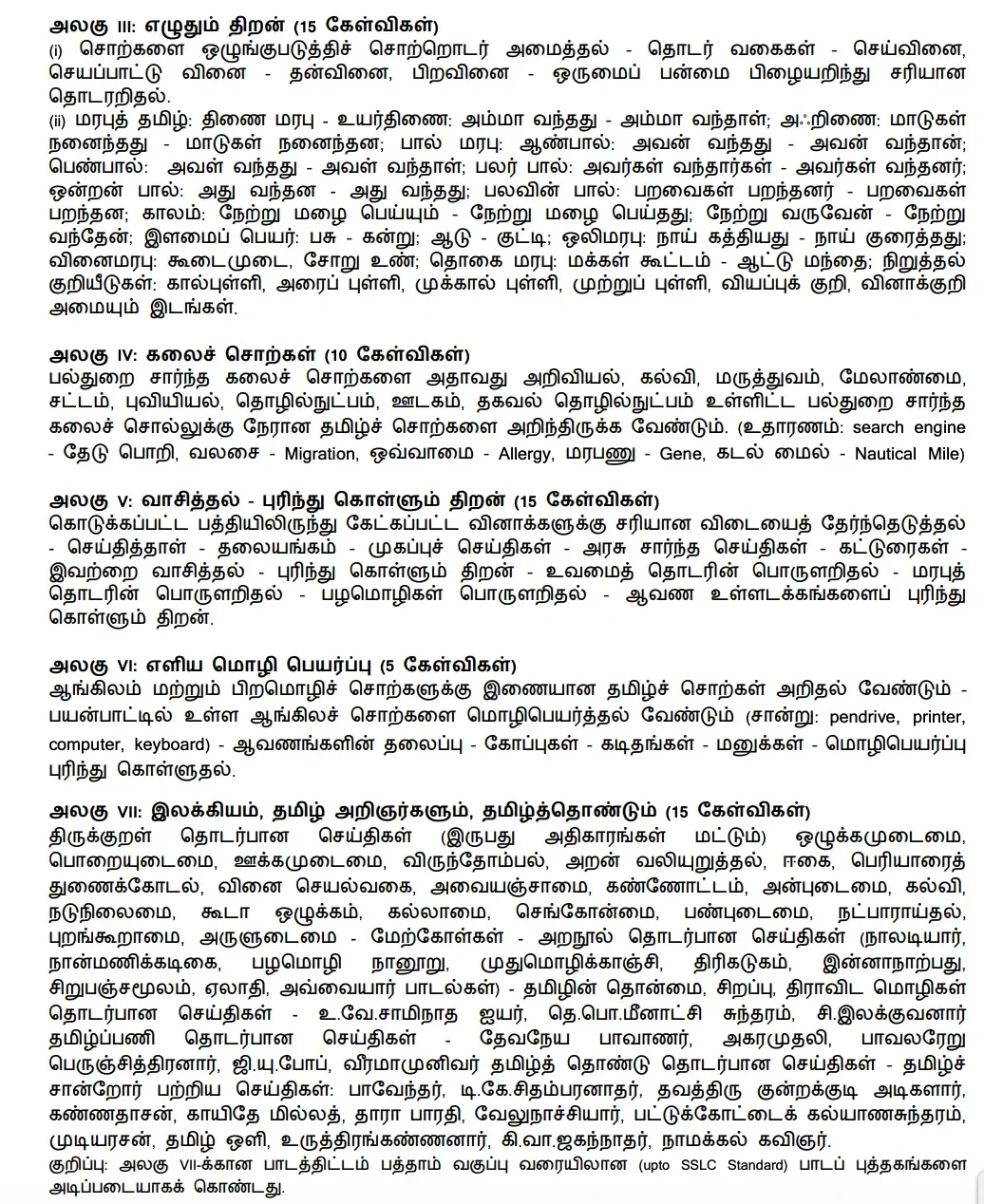
The preliminary examination carries a maximum of 300 marks and a duration of 3 hours with 200 questions in total. All Prelims questions are bilingual (English and Tamil). The minimum qualifying mark for the TNPSC Prelims Exam is 90 out of 300. Prelims questions from General Tamil/General English, Aptitude and Mental Ability Test are of S.S.L.C. Standard level, while General Studies questions are of Degree Standard level.
| Subjects | Number of Questions | Maximum marks | Duration |
|---|---|---|---|
| General Tamil (S.S.L.C. Standard) or General English (S.S.L.C. Standard) | 100 | 300 | 3 hours |
| General Studies (Degree Standard) | 75 | 300 | 3 hours |
| Aptitude and Mental Ability Test (S.S.L.C. Standard) | 25 | 300 | 3 hours |
| Total | Total | 300 | 3 hours |
Mains consists of Paper 1 (100 marks) and Paper 2 (300 marks). Paper 1 in Mains is a Tamil Eligibility Test (SSLC level, descriptive, qualifying in nature, 1 hour 30 minutes duration). Paper 2 in Mains is General Studies (Degree level, objective/scoring, 3 hours duration).
| Papers | Name of Paper | Level | Total Marks | Nature |
|---|---|---|---|---|
| Paper I | Tamil Eligibility Test | SSLC | 100 | Qualifying |
| Paper II | General Studies | Degree | 300 | Scoring |
Qualifying Criteria for Group 2 vs Group 2A
| Interview Post (Group 2) | Non-Interview Post (Group 2A) |
|---|---|
| • Main Written Examination: 300 Marks • Oral Test: 40 Marks • Total Marks: 300+40 = 340 Marks • Minimum Qualifying Marks: 102 out of 340 | • Main Written Examination: 300 Marks • Total Marks: 300 • Minimum Qualifying Marks: 90 out of 300 |
The TNPSC Group 2A 2026 exam includes 4 papers as outlined below:
| Papers | Name of Paper | Level | Type of Exam | Nature | Question | Total Marks |
|---|---|---|---|---|---|---|
| 1 | Tamil Eligibility Test | SSLC | Descriptive | Qualifying | - | 100 |
| 2 | General Studies | Degree | Objective | Scoring | 100 | 150 |
| 3 | General Intelligence and Reasoning | SSLC | Objective | Scoring | 40 | 60 |
| 4 | Language (General Tamil or General English) | SSLC | Objective | Scoring | 60 | 90 |
Comprehensive Subject-Wise Syllabus Breakdown
A thorough breakdown of topics ensures focused preparation across core subject areas.
General Studies Topics
| Subjects | Topics |
|---|---|
| General Science | • Scientific Knowledge and Scientific temper - Power of Reasoning - Rote Learning Vs Conceptual Learning - Science as a tool to understand the past, present and future • Nature of Universe - General Scientific Laws – Mechanics - Properties of Matter, Force, Motion and Energy - Everyday application of the basic principles of Mechanics, Electricity and Magnetism, Light, Sound, Heat, Nuclear Physics, Laser, Electronics and Communications • Elements and Compounds, Acids, Bases, Salts, Petroleum Products, Fertilizers, Pesticides • Main concepts of Life Science, Classification of Living Organisms, Evolution, Genetics, Physiology, Nutrition, Health and Hygiene, Human diseases • Environment and Ecology |
| Current Events | • History - Latest diary of events - National symbols - Profile of States - Eminent personalities and places in news – Sports - Books and authors • Polity - Political parties and political system in India - Public awareness and General administration - Welfare oriented Government schemes and their utility, Problems in Public Delivery Systems • Geography - Geographical landmarks • Economics - Current socio-economic issues • Science - Latest inventions in Science and Technology • Prominent Personalities in various spheres – Arts, Science, Literature and Philosophy. |
| Geography of India | • Location – Physical features - Monsoon, rainfall, weather and climate - Water resources - Rivers in India - Soil, minerals and natural resources - Forest and wildlife - Agricultural pattern • Transport - Communication • Social geography – Population density and distribution - Racial, linguistic groups and major tribes • Natural calamity – Disaster Management – Environmental pollution: Reasons and preventive measures – Climate change – Green energy |
| History & Culture of India | • Indus valley civilization - Guptas, Delhi Sultans, Mughals and Marathas - Age of Vijayanagaram and Bahmani Kingdoms - South Indian history • Change and Continuity in the Socio-Cultural History of India • Characteristics of Indian culture, Unity in diversity – Race, language, custom • India as a Secular State, Social Harmony |
| Indian Polity | • Constitution of India - Preamble to the Constitution - Salient features of the Constitution - Union, State and Union Territory • Citizenship, Fundamental Rights, Fundamental duties, Directive Principles of State Policy • Union Executive, Union legislature – State Executive, State Legislature – Local governments, Panchayat Raj • Spirit of Federalism: Centre-State Relationships • Election - Judiciary in India – Rule of law • Corruption in public life – Anti-corruption measures – Lokpal and Lok Ayukta - Right to Information - Empowerment of women - Consumer protection forums, Human rights charter |
| Indian Economy | • Nature of Indian Economy – Five year plan models - an assessment – Planning Commission and Niti Ayog • Sources of revenue – Reserve Bank of India – Fiscal Policy and Monetary Policy - Finance Commission – Resource sharing between Union and State Governments - Goods and Services Tax • Structure of Indian Economy and Employment Generation, Land reforms and Agriculture - Application of Science and Technology in agriculture - Industrial growth - Rural welfare oriented programmes – Social problems – Population, education, health, employment, poverty |
| History, Culture, Heritage and Socio-Political Movements in Tamil Nadu | • History of Tamil Society, related Archaeological discoveries, Tamil Literature from Sangam age till contemporary times • Thirukkural: • Significance as a Secular literature • Relevance to Everyday Life • Impact of Thirukkural on Humanity • Thirukkural and Universal Values - Equality, Humanism, etc • Relevance to Socio - Politico-Economic affairs • Philosophical content in Thirukkural • Role of Tamil Nadu in freedom struggle - Early agitations against British Rule - Role of women in freedom struggle • Evolution of 19th and 20th Century Socio-Political movements in Tamil Nadu - Justice Party, Growth of Rationalism - Self Respect Movement, Dravidian movement and Principles underlying both these movements, Contributions of Thanthai Periyar and Perarignar Anna |
| Development Administration in Tamil Nadu | • Human Development Indicators in Tamil Nadu and a comparative assessment across the Country – Impact of Social Reform movements in the Socio-Economic Development of Tamil Nadu • Political parties and Welfare schemes for various sections of people – Rationale behind Reservation Policy and access to Social Resources - Economic trends in Tamil Nadu – Role and impact of social welfare schemes in the Socio-Economic development of Tamil Nadu • Social Justice and Social Harmony as the Cornerstones of Socio-Economic development • Education and Health systems in Tamil Nadu • Geography of Tamil Nadu and its impact on Economic growth • Achievements of Tamil Nadu in various fields • e-governance in Tamil Nadu |
General Intelligence and Reasoning Topics
| Subjects | Topics |
|---|---|
| General Intelligence and Reasoning | • Simplification – Percentage - Highest Common Factor (HCF) - Lowest Common Multiple (LCM) • Ratio and Proportion • Simple interest - Compound interest - Area - Volume - Time and Work • Logical Reasoning - Puzzles - Dice - Visual Reasoning - Alphanumeric Reasoning – Number Series |
General English Syllabus Breakdown
| Subjects | Topics |
|---|---|
| General English- Grammar (Part A) | • Phrases • Synonyms • Antonyms • Prefix & Suffix • Fill in the blanks • Prepositions • Tenses • Voice • Homophones • Error Detection • Comprehension • Odd one out • Word Formation • Identify the sentence • Compound words |
| General English- Literature (Part B) | • Figure of Speech • Appreciation Questions from Poetry • Important Lines from Poem • Biography of Important persons • Shakespeare • Oscar Wilde • Dr Karl Paulnack • Comprehension Question from Motivational Essays • British English-American English • Comprehension Question from Description of Place |
| General English- Author & Literary Work (Part C) | • Poem & Poets • Author & their stories • Biography & Auto Biography • Characters, Quotes, Important Lines of Indian Authors • Nationality of story • Drama • Folk Arts • About Poets, Dramatist • Famous Quotes • Various Works of Author Period of the poets • Nature centred Literary works and global issue Environment & Conservation • Theme observed in Literary Work |
Mains Descriptive Paper Topics
| Subjects | Topics |
|---|---|
| Tamil to English translation | • Phrases, Synonyms, Antonyms, Prefix & Suffix, Fill in the blanks, Prepositions, Tenses, Voice, Homophones, Error Detection, Comprehension, Odd one out, Word Formation, Identify the sentence, Compound words |
| English to Tamil translation | • The figure of Speech, Appreciation Questions from Poetry, Important Lines from Poem, Biography of Important persons, Shakespeare, Oscar Wilde, Dr. Karl Paulnack, Comprehension Questions from Motivational Essays, British English-American English, Comprehension Questions from Description of Places |
| Precis writing | • Phrases, Synonyms, Antonyms, Prefix & Suffix, Fill in the blanks, Prepositions, Tenses, Voice, Homophones, Error Detection, Comprehension, Odd one out, Word Formation, Identify the sentence, Compound words |
| Hints Development | • Poem & Poets, Author & their stories, Biography & Autobiography, Characters, Quotes, Important Lines of Indian Authors, Nationality of story, Drama, Folk Arts, About Poets, Dramatist, Famous Quotes, Various Works of Author, Period of the poets, Nature-centered Literary works and global issue Environment & Conservation, Theme observed in Literary Work |
| Essay Writing in Thirukkural | • Essay writing on the following topics from ‘Thirukkural’ (a) Significance as Secular literature (b) Relevance to Everyday Life (c) Impact of Thirukkural on Humanity (d) Thirukkural and Universal Values – Equality, Humanism, etc. (e) Relevance to Socio- Political- Economic affairs (f) Philosophical content in Thirukkural |
Mains Detailed Units
| Units | Topics |
|---|---|
| Modern History of India with specific reference to Tamil Nadu | • The advent of Europeans: The Portuguese, the Dutch, the English, the Danish and the French; • Expansion of British rule: Carnatic Wars; • Early uprisings against British Rule: Revolt of Poligars, South Indian Rebellion, Vellore Mutiny, Indian National Movements – Moderates, Extremists and Terrorist Movements – Gandhian Era; • The early stage of Freedom movement in Tamil Nadu – First voice for freedom struggle from Tamil Nadu – Protests by Pulithevar, Veerapandya Kattabomman, Dheeran Chinnamalai, Velunachiar, Kuyili and others • Role of Tamil Nadu in freedom struggle – V.O.Chidambaram, Bharathiyar, V.V. Subramanian, Vanchinathan, Subramania Siva, T.S.S Rajan, Rajaji, Sathyamoorthy, Kamaraj, Rukmani Lakshmi Pathi, Ambujammal and others; Types of freedom struggle – Sacrifices – Magazines – Literature – Plays/Drama – Songs – Films etc. • Contribution of women in the freedom struggle and social work: Dr Muthulakshmi Ammaiyar, Muvalur Ramamirtham, Cuddalore Anjalai mmal, Thillaiyadi Valliammai, and others • Impact of British Rule: Christian Missionaries, Development of Education, Judiciary, Local Self Governance System, Police, Transport and Communication – Disappearance of Indigenous Industries – Spread of Western Culture • Origin and Growth of “Social – Justice” ideology, Socio- Religious Movements, Political Parties and Achievements. |
| Tamil Society – Culture and Heritage | • Ancient Tamil Society – Archeological excavation evidence – Arikamedu, Adichanallur, Keezhadi – Sangam Literature – Classical Tamil; • Thirukkural – Guidance for way of life to human elevation – Guidelines given by Thirukkural in the field of administration, judiciary and day to day life – Philosophical thoughts laid down by Thirukkural for the betterment and integration of the whole of humanity; • Sociopolitical movements of 19th and 20th centuries, Vallalar’s Samarasa Sutha Sanmarga Satya Sangam –Origin and development of Justice Party – Impact of Rationalism Movement, Self-Respect Movement, History and Development of Dravidian Movement, Tani Tamil Iyakkam (Pure Tamil Movement) – Tamil Society Reforms personalities – Thanthai Periyar, Arignar Anna, and other scholars; • Arts – Cultura conventions of Tamilians – Ancient cultural knowledge of Tamilians – Conventional thoughts of Tamilians; • Cultural Elements: Tamil Nadu State Government Symbols – Experts in Cultural Fields – Folk Dances, Folk Music, Folk Drama, and World Tamil Conferences. |
| Social Issues in India with specific reference to Tamil Nadu | • Population Explosion: Fertility – Mortality – Migration – Morbidity – Census 2011 – Population control programmes – National Population Policy 2000 – Family planning and its achievements; • Health Care: Poor sanitation – Rural and Urban disparities – Poor infrastructure – Insufficient health care delivery – Role of Panchayat Raj and Urban Development Agencies – Health policy in India – Health care programmes in India; Child Labour and Child Abuse: Child Education – School Dropouts – Gender disparities – Initiatives to eliminate Child Labour in India – Media and enhanced vulnerability – Laws to protect child abuse and welfare schemes; • Women Empowerment: Domestic violence – Dowry problems – Sexual assault – Eve teasing – Kidnapping – Laws and awareness programmes – Role of Government and NGOs in women empowerment – Welfare schemes; • Marginalised Groups: Problems – Scheduled Castes and Scheduled Tribes – Elderly – People with disability – Transgender – Religious minorities – Central and State Government welfare programmes to marginalised groups. • Social Changes: Urbanization – Modernization – Globalization – Policy, Planning and Programmes in India – Impact of Violence on Society – Religious Violence – Terrorism and Communal Violence – Causes and Remedies; • Current Affairs. |
| Science and Technology in Development | • Robotics and Applications; Atomic and Nuclear Physics – Applications of nuclear energy; • Diodes and Transistors and their Applications; • Broadcasting Technology; • Electrochemical cells – Types of electrodes – Batteries – Lithium-ion Battery; Fuels: Gaseous fuels – LPG, Natural gas and water gas; • Polymers: Thermoplastics and Thermosetting plastics, PVC, PET, Nylon 66, Teflon; • Medicinal Chemistry: Analgesics – Paracetamol and Aspirin, Antibiotics – Penicillin and Chloromycetin; • Biotechnology: Applications of Biotechnology – Plant Genetic Engineering – concepts – transgenic plants, edible vaccines, Terminator Gene technology, BT Cotton, Golden rice, Flavr Savr tomato, Social and ecological impact of genetically modified crops – Biotechnological methods for crop improvement – Application of plant tissue culture in Forestry, Horticulture – Recombinant DNA Technology – DNA cloning – DNA fingerprinting – applications of PCR and ELISA in disease diagnosis – hybridoma techniques in the production of Mono Clonal Antibodies (MCA) – Animal cell culture techniques – stem cells and its applications; Applications of GIS; • Nanotechnology – Fundamentals – Applications – Nano Fertilizer, Nano Pesticides, Green Nanotechnology and Nano farming; Advanced reproductive techniques: In-vitro fertilization (IVF) – Intra–Uterine Insemination (IUI) – Intra Cytoplasmic Sperm Injection (ICSI) – Gamete Intra-Fallopian Transfer (GIFT) – cryopreservation of sperm; Components of Computer – Computer Organization and Architecture – System Software and Application Software –Data Communication Networks – Cryptography – Computer Graphics and Multimedia – Mobile Computing and Communication – Web Technology and Applications – E-Commerce – Cloud Computing Architecture – IOT – Artificial Intelligence Applications – Machine learning – Cyber Security – Biometrics – Blockchain Technology; • Current Affairs. |
| Constitution, Polity and Governance in India with specific reference to Tamil Nadu | • Constitution of India: Preamble and Philosophical features – Salient features and Sources – Union, States and Union Territories – • Citizenship • Fundamental Rights • Fundamental Duties • Directive Principles of State Policy; • Union Executive: President, Vice-President, Prime Minister and Council of Ministers – Cabinet – Parliament (Lok Sabha and Rajya Sabha) – Parliament Committees – Major Constitutional Amendments; • State Government: Chief Minister and Council of Ministers – Tamil Nadu Legislative Assembly: Structure, Powers and Functions; Local Governments: Three-tier system – 73rd and 74th Constitutional Amendments – Tamil Nadu Panchayat Act 1994 – Grama Sabha – Working of PRIs in Tamil Nadu – District Collector’s role in Development Administration; • Dynamics of Indian Federalism: Centre-State relations: Administrative, Legislative, Financial – Issues and Challenges; • Judiciary in India: Supreme Court, High Courts, District Courts – Subordinate Courts (Structure and Functions) – Judicial Review – Judicial Activism – Public Interest Litigation; Electoral System in India – Election Commission (Constitutional Provisions, Composition, powers and functions); • Party system in India: Regional and National political parties in India and Tamil Nadu; • Integrity in Indian Polity: Corruption in Politics – Anti-Corruption measures: Lokpal and Lok Ayukta – Central Vigilance Commission, Comptroller and Auditor General of India – Central Bureau of Investigation – Enforcement Directorate – Right to Information – Right to Services – Consumers’ Rights – Consumer Protection Act 2019 – Human Rights Act 1993 – National Human Rights Commission, State Human Rights Commission – Social Audit – Citizen’s Charter; • Political parties in Tamil Nadu: Regional and National Parties – Welfare schemes and measures of successive Governments in Tamil Nadu after 1947 – Reservation and Language policy in Tamil Nadu – Impact of welfare schemes and measures in the socio-economic development of Tamil Nadu; • Education and Health Administrative Structure in Tamil Nadu: Evolution – Achievements of Tamil Nadu in various fields: Education, Health, Industrial, Information Technology, Agriculture, Women and Marginalised Groups; • E-governance and Mobile– governance initiatives in Tamil Nadu – Public Service Delivery through e-governance. TNeGA – eService Centres; • Problems in Public Service delivery in Tamil Nadu; • Current Affairs. |
| Geography of India, Environment, Biodiversity and Disaster Management in India with specific reference to Tamil Nadu | • Geographical Location – Physical units – River system – Climate – Soil – Natural vegetation – Agriculture crops – Livestock – Fisheries; Irrigation – Multipurpose Projects; • Minerals: iron ore, manganese, copper, bauxite, gold, silver, mica, coal, petroleum and natural Gas; • Energy Resources: hydel, thermal, nuclear, wind, tidal and solar; • Industries: textile, jute, sugar, cement, iron and steel, automobile and shipbuilding; • Transport: road, railway, water and air; • Environment – Global and national environmental issues – pollution – air, water, soil, thermal, radioactive, noise, electronic and solid wastes – Management of municipal solid wastes and bio-medical wastes; • Biodiversity and Conservation: Definition, types – genetic, species and ecosystem diversity – values – threats to biodiversity – habitat destruction, invasive species and anthropogenic activities – climatic change and wildfire; • Causes and consequences of species extinction; • Biodiversity conservation: in-situ and ex-situ; • Biodiversity conservation strategies: international environmental governance – Biodiversity Act (BDA), International Union for Conservation of Nature (IUCN), Convention on International Trade in Endangered Species (CITES), and World Wide Fund for Nature (WWF); • Biodiversity hotspots of India; • Sustainable development – Sustainable development goals and targets – • Clean and Green energy Paris Agreement and COP28; • Disaster Management: Overview of disasters – definitions and types; • Introduction to disaster risk management framework; • Natural calamities – Anthropogenic disasters – global warming and climate change, industrial accidents; • Climate change governance – mitigations and adaptations; • Role of space technology in disaster management, National action plan for climate change – Tamil Nadu State Disaster Management Authority – Tamil Nadu Disaster Management Plan – Role of NGO and Civil society organisation in disaster management and mitigation in Tamil Nadu; • Current Affairs. |
| Indian Economy with specific reference to Tamil Nadu | • Nature of Indian Economy: An assessment – Structure of Indian Economy – New Economic Policy: Rationale – Components – Privatisation, Deregulation, Trade Liberalisation. Indian Economy since 1991 Reforms (Overview only) – Sources of Revenue: Revenue Receipts – Capital Receipts – Revenue Expenditure – Capital Expenditure; • Reserve Bank of India: Functions, Monetary Policy – Components – Fiscal Policy: Fiscalreforms – Fiscal Responsibility and Budgetary Management (FRBM) Act Finance Commission: Revenue sharing between Union and State Governments – Recommendations of recent Finance Commission; • Agricultural and Rural Development: Land Reforms – Rural Credit, Modern Farming Technics and Marketing – e-NAM (electronic – National Agricultural Marketing) – Price Policy – M.S. Swaminathan Commission’s Recommendations – Subsidies – Commercialisation and Diversification of Agriculture – Rural Development Programmes – Poverty Alleviation Programmes – National Rural Employment Guarantee Scheme (NREGS); • Labour: Employment – Types – Sectoral Distribution – Labour Welfare Measures – Recent Indian Employment Report of International Labour Organisation (ILO) (Overview only); • Poverty and Human Development: Estimates of Inequality and Poverty alleviation measures – Human Development Index (HDI), Gender Development Index (GDI), Gender Empowerment Measure (GEM) and Happiness Index (HI); Foreign trade: Composition, Direction and Organisation of Trade – Foreign Direct Investment (FDI) – Balance of Trade – Balance of Payment – External Debt; • Current Affairs. |
Recommended Preparation Books
Equipping yourself with standard text references is vital. Refer to the checklist of essential books below:
- General Studies (History, Geography, Polity, Science, Economy): Samacheer Kalvi State Board Books- Classes 6th to 12th
- Tamil Nadu History and Culture: Assam Publications Unit-VI book
- Indian Polity: Indian Polity by M.Laxmikanth
- General Knowledge/Current Affairs: Arihant General Knowledge; The Hindu Tamil/English daily
- Quantitative Aptitude: R.S. Aggarwal-Quantitative Aptitude
- General Tamil: Samacheer Kalvi Tamil books 6th-12th; TNPSC-specific Tamil guides
- General English: Samcheer Kalvi English books 6th-12th; Wren & Martin for grammar
| Subject | Recommended Books/Sources |
|---|---|
| General Studies (History, Geography, Polity, Science, Economy) | Samacheer Kalvi State Board Books- Classes 6th to 12th (Primary Source) |
| Tamil Nadu History and Culture | Assam Publications Unit-VI book (Tamil Nadu History, Culture, Social-Political Movements) |
| Indian Polity | Indian Polity by M.Laxmikanth |
| General Knowledge/Current Affairs | Arihant General Knowledge; The Hindu Tamil/English daily |
| Quantitative Aptitude | R.S. Aggarwal-Quantitative Aptitude |
| General Tamil | Samacheer Kalvi Tamil books 6th-12th; TNPSC-specific Tamil guides |
| General English | Samcheer Kalvi English books 6th-12th; Wren & Martin for grammar |
Study Plan & Preparation Strategy
To clear the examination efficiently, adopt a disciplined 6-month study schedule broken down month by month:
| Month | Focus |
|---|---|
| Month 1-2 | Read Samacheer Kalvi Class 6-10 (Social Science and Science) cover to cover |
| Month 3 | Class 11-12 subjects (Polity, Economy, Geography); begin current affairs habit |
| Month 4 | Tamil Nadu-specific units (Unit VI & VII)- highest weightage; solve 2019–2021 papers |
| Month 5 | Full syllabus revision + mock tests daily; General Tamil/English practice |
| Month 6 | Previous year papers, speed tests, Mains answer writing practice |
Syllabus Resources & Downloadable PDFs
For offline reference, download the official syllabus documents:
- TNPSC Group 2 Prelims Syllabus PDF
- TNPSC Group 2 Eligibility Test Syllabus PDF
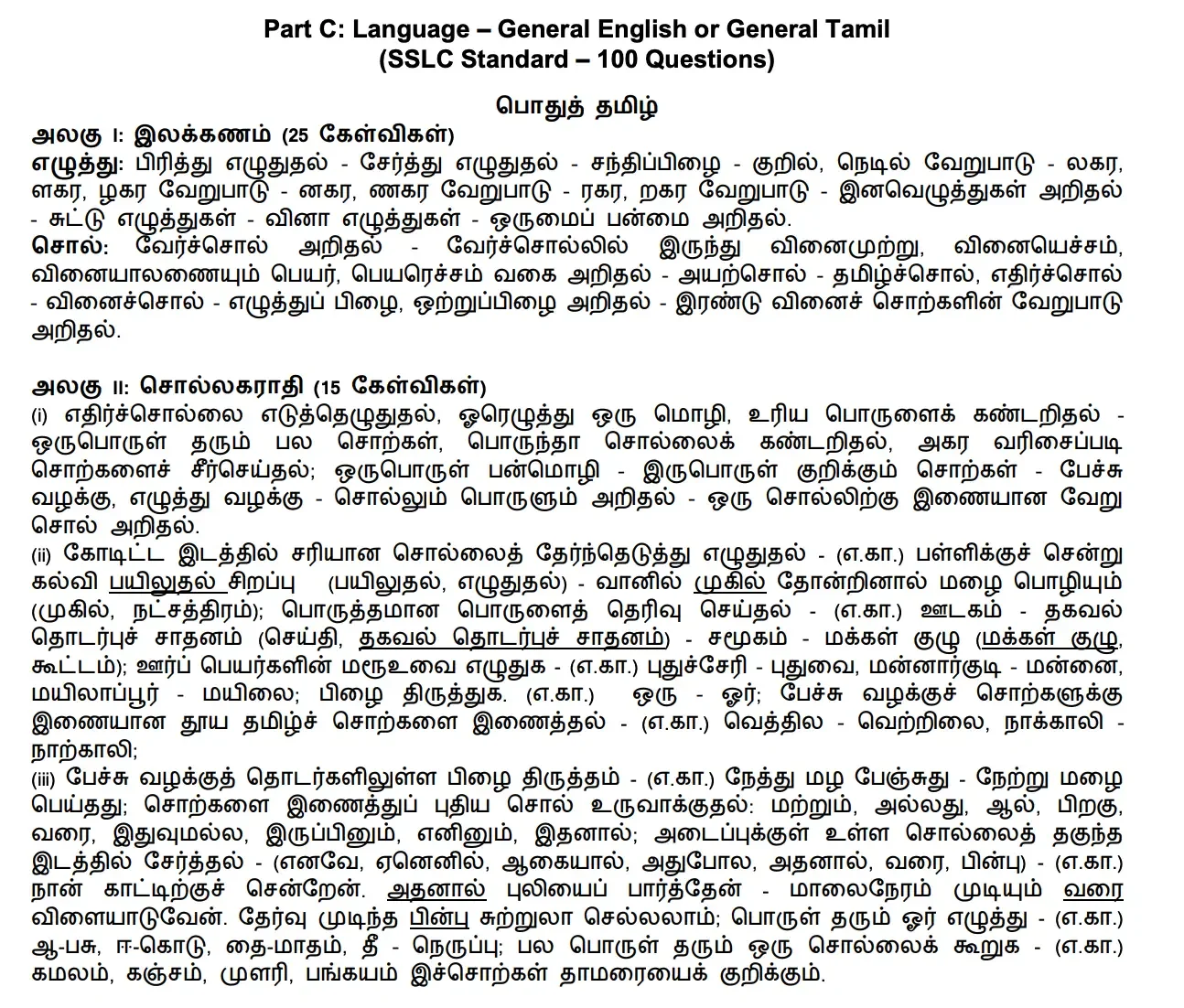
- TNPSC Group 2 & 2A Language (General Tamil) Preliminary Examination PDF
- TNPSC Group 2 Tamil Eligibility Test Mains Examination PDF
- TNPSC Group 2 General Studies Mains Examination PDF
- TNPSC Group 2 Paper II - GS Descriptive Mains Examination PDF
- TNPSC Group 2A Tamil Eligibility Test Mains Examination PDF
- TNPSC Group 2A Mains General Studies PDF
| Syllabus Section | Format / Link |
|---|---|
| TNPSC Group & 2 & 2A Language (General Tamil) | Download PDF |
| Language (General English) | Reference PDF |
| Aptitude and Mental Ability | Reference PDF |
| General Studies | Reference PDF |
| TNPSC Group 2 Tamil Eligibility Test | Download PDF |
| TNPSC Group 2 General Studies | Download PDF |
| TNPSC Group 2 Paper II - GS Descriptive | Download PDF |
| TNPSC Group 2A Tamil Eligibility Test | Download PDF |
| TNPSC Group 2A General Studies | Download PDF |
What to Do Next
After reviewing the exam pattern and downloading your respective syllabus PDFs, aspirants should immediately organize their study desk with Samacheer Kalvi textbooks and track daily study hours. Keep an eye on www.tnpsc.gov.in for official announcements regarding hall ticket releases, application deadlines, and exam center allocations.
Frequently Asked Questions (FAQs)
Recommended Reads
- TNPSC Group 2 & 2A Exam 2026: Eligibility, Age Limits & Qualifications
- TNPSC Group 2 Salary 2026: Post-Wise Pay Levels, Structure & Perks
- TNPSC Group 2 Mains Result 2026 Declared: Direct Link & Scorecard
- TNPSC Group 2 Notification 2026: Apply Online for 821 Vacancies
- TNPSC Group 2 Notification 2025: Apply for 645 Vacancies Before August 13
- TNPSC Group 2 Prelims Result 2026: Check Date, Scorecard & Cut Off
- TNPSC Group 2 & 2A Prelims Answer Key 2026: Download, Objections & Scoring Guide
- TNPSC Group 2 Result 2025: Cut-Off Marks, Selection Process & Qualifying Criteria
- TNPSC Group 2 & 2A Mains Hall Ticket 2026 Released: Download Link & Exam Dates
Sarkari Exam Typing Speed & Accuracy Test
Test your typing speed (Gross & Net WPM) in English & Hindi against SSC CHSL 35 WPM / 95% accuracy standards.
Never miss another exam update!
Get the fastest exam results, recruitment news, and educational guides delivered directly to your phone.