In English grammar, tenses are essential for indicating the time at which an action occurs. By modifying verb forms, we can specify whether an event happened in the past, is occurring in the present, or will take place in the future. There are three primary categories: present, past, and future, each subdivided into Simple, Continuous, Perfect, and Perfect Continuous forms. This guide provides a detailed breakdown of all 12 tenses with clear rules and examples.

What is Tense?
According to Oxford Dictionary, “Tense is any of the forms of a verb that may be used to show the time of the action or situation expressed by the verb”.
According to Merriam-Webster Dictionary, “The term tense means a distinction of form in a verb to express distinctions of time or duration of the action or state it denotes”.
According to Collins Dictionary, “Tense is defined as any of the forms of a verb which reveal the time at which an action has happened”.
According to Cambridge Dictionary, “Tense” is “any of the forms of a verb which show the time at which an action happened.”
Types of Tense
In English grammar, there are three primary tenses:
- Present Tense
- Past Tense
- Future Tense
Each category further consists of four forms:
- Simple
- Perfect
- Continuous
- Perfect Continuous
Consequently, there are 12 distinct tenses in total, categorized as follows:
| Tenses | Tenses forms |
| Present Tense | Simple Present Tense |
| Present Perfect Tense | |
| Present Continuous Tense | |
| Present Perfect Continuous Tense | |
| Past Tense | Simple Past Tense |
| Past Perfect Tense | |
| Past Continuous Tense | |
| Past Perfect Continuous Tense | |
| Future Tense | Simple Future Tense |
| Future Perfect Tense | |
| Future Continuous Tense | |
| Future Perfect Continuous Tense |
The following table provides a comprehensive overview of tense examples:
| Tense | Forms | Examples |
| Present Tense | Simple Present Tense | He drives a car |
| Present Perfect Tense | He is driving a car | |
| Present Continuous Tense | He has driven a car | |
| Present Perfect Continuous Tense | He has been driving a car since morning | |
| Past Tense | Simple Past Tense | He drove a car |
| Past Perfect Tense | He was driving a car | |
| Past Continuous Tense | He had driven a car | |
| Past Perfect Continuous Tense | He had been driving the car since 7 am | |
| Future Tense | Simple Future Tense | He will drive a car |
| Future Perfect Tense | He will be driving a car | |
| Future Continuous Tense | He will have driven a car | |
| Future Perfect Continuous Tense | He will have been driving the car at 6 am tomorrow |
Significance of Tense Chart
In English grammar, tenses are a fundamental concept. A verb changes its form based on the tense to ensure sentences are grammatically correct and convey the precise timing of an action or state. Mastering all twelve tenses allows you to build complex and nuanced sentences. Use the reference chart below to improve your understanding of English tenses.
Tense Chart with Rules and Examples
| Tense Chart | ||
|---|---|---|
| Tenses | Rules and Formula | Examples |
| Simple Present Tense | Subject + Verb in the base form/third person plural form + the rest of the sentence | Rajesh eats bread and butter before going to school. |
| Present Continuous Tense | Subject + Helping Verb(am/is/are) + Main verb + ing + the rest of the sentence | Students are going to school. |
| Present Perfect Tense | Subject + Helping Verb (have/has) + Past participle of the main verb + the rest of the sentence along with the time frame | She has lived here all her life. |
| Present Perfect Continuous Tense | Subject + Have/Has + Been + Verb+ ing + the rest of the sentence | I have been working on this project for a week. |
| Simple Past Tense | Subject + Verb + ed / verb in the past tense + the rest of the sentence | Nupur went to the supermarket yesterday. |
| Past Continuous Tense | Subject + Helping Verb(was/were) + Main verb + ing + the rest of the sentence | It was snowing today. |
| Past Perfect Tense | Subject + Helping Verb (had) + Past participle of the main verb + the rest of the sentence along with the time frame. | She had met him before the party. |
| Past Perfect Continuous Tense | Subject + Had + Been + Verb + ing + the rest of the sentence | He had been drinking milk out the carton when Mom walked into the kitchen. |
| Simple Future Tense | Subject + will/shall + V1 + Object | I will write articles on different topics. |
| Future Continuous Tense | Subject + will be/shall be + V1 + ing + Object | I will have been waiting here for three hours by six o'clock. |
| Future Perfect Tense | Subject + will have/shall have + V3 + Object | I will have dressed up by the time you reach home. |
| Future Perfect Continuous Tense | Subject + will have been + V1 + ing + Object | I will have been waiting here for three hours by six o'clock. |
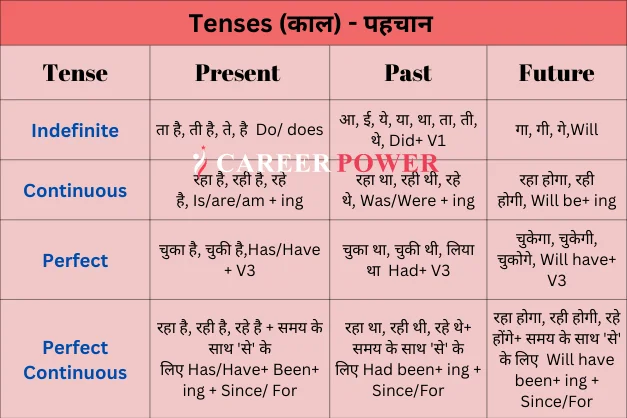
Tense Chart In Hindi
Tense (काल) क्रिया का वह स्वरूप है जो किसी कार्य या घटना के समय और उस कार्य या घटना की स्थिति को बताता है। मुख्यतया काल तीन प्रकार के होते हैं: वर्तमान काल (Present Tense), भूतकाल (Past Tense), और भविष्यकाल (Future Tense)। इस लेख में, हम विस्तार से इन तीनों कालों के भेदों और उनके उपयोग को समझेंगे।
| Tenses (काल) - पहचान | |||
|---|---|---|---|
| Present | Past | Future | |
| Indefinite | ता है, ती है, ते हैं, है Do/ does | आ, ई, ये, या, था, ता, ती, थे, Did+ V1 | गा, गी, गे, Will |
| Continuous | रहा है, रही है, रहे हैं, Is/are/am + ing | रहा था, रही थी, रहे थे, Was/Were + ing | रहा होगा, रही होगी, Will be+ ing |
| Perfect | चुका है, चुकी है, Has/Have + V3 | चुका था, चुकी थी, लिया था Had+ V3 | चुकेगा, चुकेगी, चुकोगे, Will have+ V3 |
| Perfect Continuous | रहा है, रही है, रहे हैं + समय के साथ 'से' के लिए Has/Have+ Been+ ing + Since/ For | रहा था, रही थी, रहे थे+ समय के साथ 'से' के लिए Had been+ ing + Since/For | रहा होगा, रही होगी, रहे होंगे+ समय के साथ 'से' के लिए Will have been+ ing + Since/For |
Present Tense
The present tense describes actions or states happening in the current time. It is used to express events that are ongoing, habitual, or factual. Below is the tense chart for the Present Tense.
Types of Present Tense
In English grammar, there are four types of present tense:
- Simple Present Tense
- Present Continuous Tense
- Present Perfect Tense
- Present Perfect Continuous Tense
1. Simple Present Tense: This tense is used to describe habitual actions, universal truths, or events occurring in the present.
General Formula for Simple Present Tense:
| Subject + Verb in the base form/third person plural form + the rest of the sentence |
Simple Present Tense Examples:
- Rajesh eats bread and butter before going to school.
- Elisa watches cartoons every day.
- Rupa drinks milk every night before going to bed.
- John goes to the gym daily.
- Dileep smokes.
- Shilpa reads the newspaper every day.
2. Present Continuous Tense: This tense describes actions that are currently in progress or ongoing at the present moment.
General formula for Present Continuous Tense:
| Subject + Helping Verb(am/is/are) + Main verb + ing + the rest of the sentence |
Present Continuous Tense Examples:
- Students are going to school.
- The girls are playing in the park.
- Rupali is crying out loud.
- It is raining now.
- I am cooking biryani for the lunch.
- Miss Angela is teaching in the class.
3. Present Perfect Tense: This tense is used for actions that were completed at an indefinite time in the past or have relevance to the present.
General Formula for Present Perfect Tense:
| Subject + Helping Verb (have/has) + Past participle of the main verb + the rest of the sentence along with the time frame |
Present Perfect Tense Example
- She has lived here all her life.
- They have written three letters already.
- I have worked here since I graduated school.
- He has finished his homework.
- We have been to Canada.
- She has forgotten her folder.
4. Present Perfect Continuous Tense: This tense describes actions that began in the past and are still continuing into the present.
General Formula for Present Perfect Continuous Tense:
| Subject + Have/Has + Been + Verb+ ing + the rest of the sentence |
Present Perfect Continuous Tense Examples:
- I have been working on this project for a week.
- You have been working on this project for a week.
- He has been working on this project for a week.
- She has been working on this project for a week.
- They have been working on this project for a week.
Past Tense
The past tense describes actions or events that occurred and concluded in the past. Below is the tense chart for the Past Tense.
Types of Past Tense
There are four types of past tense:
- Simple Past Tense
- Past Continuous Tense
- Past Perfect Tense
- Past Perfect Continuous Tense
1. Simple Past Tense: Used to indicate an action or event that was completed at a specific time in the past.
General Formula for Simple Past Tense:
| Subject + Verb + ed / verb in the past tense + the rest of the sentence |
Simple Past Tense Examples:
- Nupur went to the supermarket yesterday.
- Satya cooked a tasty dinner yesterday.
- My sister saw a movie yesterday.
- Last month I travelled to France.
- I washed the dishes.
- My sister bought a dress for me.
2. Past Continuous Tense: Used to describe actions that were in progress at some point in the past.
General Formula For Past Continuous Tense:
| Subject + Helping Verb(was/were) + Main verb + ing + the rest of the sentence |
Past Continuous Tense Examples:
- It was snowing today.
- They were eating at the dhaba.
- You were working tomorrow.
- I was studying last night.
- I was waiting for the cab when I met Usha.
- The student were shouting when the teacher came in.
- It was midnight when it was raining.
- Everyone was clapping.
3. Past Perfect Tense: Used to represent an action completed before another action or time in the past.
General Formula For Past Perfect Tense:
| Subject + Helping Verb (had) + Past participle of the main verb + the rest of the sentence along with the time frame. |
Past Perfect Tense Examples:
- She had met him before the party.
- The plane had left by the time I got to the airport.
- I had written the email before he apologized.
- Kate had wanted to see the movie, but she did not have money for the ticket.
4. Past Perfect Continuous Tense: This form denotes an action that was ongoing in the past up until another event occurred.
General Formula For Past Perfect Continuous Tense:
| Subject + Had + Been + Verb + ing + the rest of the sentence |
Past Perfect Continuous Tense Examples:
- He had been drinking milk out the carton when Mom walked into the kitchen.
- I had been working at the company for five years when I got the promotion.
- Martha had been walking three miles a day before she broke her leg.
- The program that was terminated had been working well since 1945.
- Cathy had been playing the piano for 35 years when she was finally asked to do a solo with the local orchestra.
- He had been throwing rocks at her window for five minutes before she finally came out on the balcony and said, “Hey, Romeo.”
Future Tense
The future tense refers to actions that have not yet happened but are expected to occur or continue in the future.
Types of Future Tense
There are four types of future tense:
- Simple Future Tense
- Future Continuous Tense
- Future Perfect Tense
- Future Perfect Continuous Tense
1. Simple Future Tense: Used to describe an action that will occur at some point in the future.
General Formula For Simple Future Tense:
| Subject + will/shall + V1 + Object |
Simple Future Tense Examples:
- I will write articles on different topics.
- Robert will read various kinds of books.
- They will play football in that field.
- April will prefer coffee to tea.
- Bob will go to the library tomorrow.
- We will go shopping in that market this Monday.
2. Future Continuous Tense: Used to denote actions that will be in progress at a specific time in the future.
General Formula For Future Continuous Tense:
| Subject + will be/shall be + V1 + ing + Object |
Future Continuous Tense Examples:
- It will be raining from tomorrow.
- I will be watching the series today.
- They will be staying at my place.
- The parcel will be arriving soon.
- The doctor will be coming tomorrow.
- The Prime Minister will be visiting the museum tomorrow.
3. Future Perfect Tense: Used to indicate an action that will be completed by a certain point in the future.
General Formula For Future Perfect Tense:
| Subject + will have/shall have + V3 + Object |
Future Perfect Tense Examples:
- I will have dressed up by the time you reach home.
- You will have dressed up by the time they reach home.
- He will have dressed up by the time you reach home.
- She will have dressed up by the time you reach home.
- They will have dressed up by the time you reach home. She will be taking her dog for a walk.
4. Future Perfect Continuous Tense: Describes verb forms that show actions continuing up until a specific point in the future.
General Formula For Future Perfect Continuous Tense:
| Subject + will have been + V1 + ing + Object |
Future Perfect Continuous Tense Examples:
- I will have been waiting here for three hours by six o'clock.
- By 2001 I will have been living in London for sixteen years.
- When I finish this course, I will have been learning English for twenty years.
- Next year I will have been working here for four years.
- When I come at 6:00, will you have been practicing long?
Key Functions of Tenses
Tenses are a crucial grammatical component for clear communication, helping to frame actions relative to time. Here are the key functions of Tenses in English:
Present Tense:
- Simple Present: Describes habitual actions, general truths, and states. [e.g., “She walks to school every day”.]
- Present Continous [Progressive]: Indicates ongoing actions happening right now or around the present time. [e.g., “She is walking to school.”]
- Present Perfect: Connects past actions or states to the present, often indicating relevance or result. [e.g., “She has walked to school.”]
- Present Perfect Continuous: Emphasizes the duration of an action that began in the past and continues into the present. [e.g., “She has been walking to school for an hour.”]
Past Tense:
- Simple Past: Describes completed actions or states that occurred at a specific time in the past. [e.g., “She walked to school yesterday.”]
- Past Continuous: Indicates outgoing actions that were happening at a specific moment in the past. [e.g., “She was walking to school when it started to rain.”]
- Past Perfect: Refers to actions or states that were completed before another past action. [e.g., “She had walked to school before it started to rain.”]
- Past Perfect Continuous: Emphasizes the duration of an action that was ongoing up to a specific point in the past. [e.g., “She had been walking to school for an hour before it started to rain.”]
Future Tense:
- Simple Future: Describes actions or states that will occur at a later time. [e.g., “She will walk to school tomorrow.”]
- Future Continuous: Indicates ongoing actions that will be happening at a specific time in the future. [e.g., “She will be walking to school at 8 am.”]
- Future Perfect: Refers to actions that will be completed before a certain future point. [e.g., "She will have walked to school by the time the ball rings."]
- Future Perfect Continuous: Emphasizes the duration of an action that will be ongoing up to a specific future point. [e.g., “She will have been walking to school for an hour by the time the bell rings.”]
Tense Chart- FAQs
Ans. In English grammar, verbs modify their form to indicate the timing or state of an action. These variations are known as Tenses.
Ans. Tense is defined as a verb form used to indicate the time of an action or situation. The three primary tenses—Present, Past, and Future—are each categorized into Simple, Continuous, Perfect, and Perfect Continuous forms.
Ans. There are 12 tenses in total: Simple Present, Present Continuous, Present Perfect, Present Perfect Continuous, Simple Past, Past Continuous, Past Perfect, Past Perfect Continuous, Simple Future, Future Continuous, Future Perfect, and Future Perfect Continuous.
Ans. In English grammar, V1 represents the base (first) form of the verb, V2 represents the past (second) form, and V3 represents the past participle (third) form.
Ans. The general formula for the Present Continuous Tense is: Subject + Helping Verb (am/is/are) + Main Verb + ing + remainder of the sentence.
Also Read:
- Present Perfect Tense: Definition, Rules, Structure, and Examples
- Future Continuous Tense: Rules, Structure, and Usage with Examples
- Future Perfect Continuous Tense: Definition, Rules, and Examples
- Future Perfect Tense: Definition, Rules, and Examples
- Past Continuous Tense: Rules, Structure, and Examples Explained
- Past Perfect Continuous Tense: Definition, Rules, and Usage Examples