Understanding square roots is a fundamental building block in mathematics. A square root of a number is defined as a value that, when multiplied by itself, produces the original number. These operations can yield both positive and negative values and are commonly denoted by the radical symbol (√) or in exponential form as x^(1/2). Within the numerical span from 1 to 30, positive values range from 1 to approximately 5.477. Typically, these figures are rounded to three decimal places for precision.
Perfect vs. Non-Perfect Squares in Range 1 to 30
When analyzing integers from 1 to 30, numbers can be separated into two distinct categories:
- Perfect Squares: The integers 1, 4, 9, 16, and 25. The number 1 is unique as the only integer whose square root is equal to itself.
- Non-Perfect Squares: The remaining numbers in the range (such as 2, 3, 5, 6, 7, etc.), which yield irrational numbers when square rooted.
Square Root 1 to 30 for Perfect Squares Checklist
- √1 = 1
- √4 = 2
- √9 = 3
- √16 = 4
- √25 = 5
Comprehensive Square Root 1 to 30 Reference Charts
Below are the detailed breakdown tables showing values for both overall figures and non-perfect values.
| Number / Expression | Approximation |
|---|---|
| Square Root from 1 to 30 Chart | |
| √1 = 1 | √2 = 1.414 |
| √3 = 1.732 | √4 = 2 |
| √5 = 2.236 | √6 = 2.449 |
| √7 = 2.646 | √8 = 2.828 |
| √9 = 3 | √10 = 3.162 |
| √11 = 3.317 | √12 = 3.464 |
| √13 = 3.606 | √14 = 3.742 |
| √15 = 3.873 | √16 = 4 |
| √17 = 4.123 | √18 = 4.243 |
| √19 = 4.359 | √20 = 4.472 |
| √21 = 4.583 | √22 = 4.690 |
| √23 = 4.796 | √24 = 4.899 |
| √25 = 5 | √26 = 5.099 |
| √27 = 5.196 | √28 = 5.292 |
| √29 = 5.385 | √30 = 5.477 |
Square Root 1 to 30 for Non-Perfect Square Numbers
| Expression A | Expression B |
|---|---|
| Square Root 1 to 30 for Non-Perfect Square Number | |
| √2 = 1.414 | √3 = 1.732 |
| √5 = 2.236 | √6 = 2.449 |
| √7 = 2.646 | √8 = 2.828 |
| √10 = 3.162 | √11 = 3.317 |
| √12 = 3.464 | √13 = 3.606 |
| √14 = 3.742 | √15 = 3.873 |
| √17 = 4.123 | √18 = 4.243 |
| √19 = 4.359 | √20 = 4.472 |
| √21 = 4.583 | √22 = 4.690 |
| √23 = 4.796 | √24 = 4.899 |
| √26 = 5.099 | √27 = 5.196 |
| √28 = 5.292 | √29 = 5.385 |
| √30 = 5.477 |
Calculation Methods for Square Roots
Depending on whether a number is a perfect or non-perfect square, different procedures apply to find its square root efficiently.
Prime Factorization Method for Perfect Squares
Prime factorization is the most efficient method for finding the square root of perfect square numbers.
- Identify the perfect square number.
- Determine the prime factors of the number.
- Group the identical prime factors into pairs.
- Take one factor from each pair to find the square root.
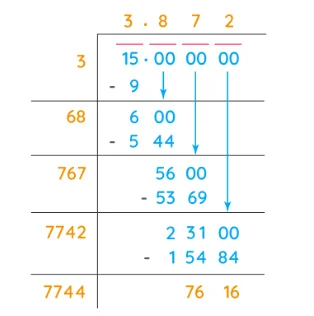
Long Division Method for Non-Perfect Squares
The long division method is typically applied to calculate square roots of non-perfect square numbers.
- Group the digits of the number in pairs from right to left (for numbers with decimals, group from the decimal point outward).
- Find the largest integer whose square is less than or equal to the first group/pair, and write it as the divisor and quotient.
- Subtract the square from the first pair and bring down the next pair.
- Double the current quotient to form the base of the next divisor, append a digit that fits the remaining value, and repeat until the desired decimal place is reached.
After reviewing these values and practicing computation methods, students should continue solving manual exercises, memorize the key perfect square anchors, and apply estimation techniques for faster mental calculations during exams.
Frequently Asked Questions (FAQs)
Recommended Reads
- Complete Educational Guide to the Perimeter of a Square: Formulas, Derivations & Examples
- How to Calculate the Area of a Square: Formulas, Examples, and Geometry Guide
- CIL MT Answer Key 2026: CBT Exam Solution PDF & Download Link
- Federal Bank Sales Officer Recruitment 2026: Apply Online for Corporate Salary Posts
- ADA Recruitment 2026: Apply for 111 Project Assistant Posts (ADV-139)
- CAIIB Exam 2026 Nov-Dec Cycle: Dates, Syllabus, Pattern & Centers
Exam Photo & Signature Resizer (20KB - 50KB)
Resize passport photo & signature to 20-50KB with Name & Date of Photo (DOP) strip or combine them in 1-click.
Never miss another exam update!
Get the fastest exam results, recruitment news, and educational guides delivered directly to your phone.