Securing a position through the Railway Recruitment Board (RRB) Non-Technical Popular Categories (NTPC) examination requires a thorough understanding of the syllabus, exam structure, and marking scheme. Whether you are aiming for graduate or undergraduate roles in 2026, mastering the curriculum and strategic preparation is key to your success. You can also review the RRB NTPC Graduate CBT 2 Answer Key 2026 Released - View and Download Here to check previous evaluation benchmarks.
For official documentation and guidelines, download the comprehensive Official RRB NTPC Syllabus PDF.
RRB NTPC Selection Process & Exam Structure
The selection process involves multiple stages designed to screen, test, and verify candidates thoroughly. Candidates should carefully review the RRB NTPC exam pattern before beginning their preparation.
- CBT 1: 100 Questions for 100 Marks
- CBT 2: 120 Questions for 120 Marks
- CBAT/ Typing Test
- Document Verification + Medical
Note that CBT 1 marks are not counted in the final merit list and serve only as a screening exam, whereas CBT 2 marks determine the final merit list. The exam is conducted in 15 languages including Hindi and English. Graduate-level exams feature a higher standard of difficulty compared to undergraduate-level assessments.
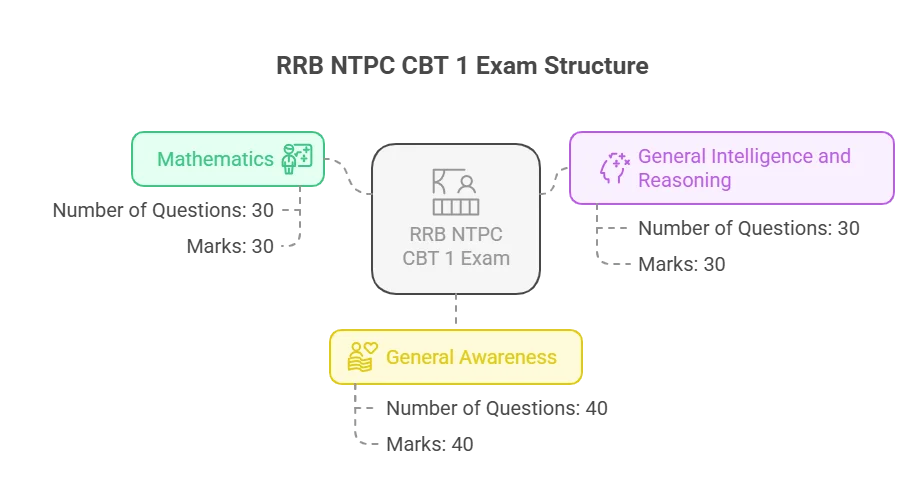
| Detail | Information |
|---|---|
| Selection Process | 1. CBT 1: 100 Questions for 100 Marks 2. CBT 2: 120 Questions for 120 Marks 3. CBAT/ Typing Test, 4. Document Verification + Medical |
| Exam Subjects | General Awareness, Mathematics, General Intelligence & Reasoning |
| Mode of Exam | Online (Computer-Based Test) |
| CBT 1 Pattern | 100 Questions / 100 Marks / 90 Minutes |
| CBT 2 Pattern | 120 Questions / 120 Marks / 90 Minutes |
| Negative Marking | Yes – 1/3rd mark per wrong answer |
| Language of Exam | 15 languages including Hindi & English |
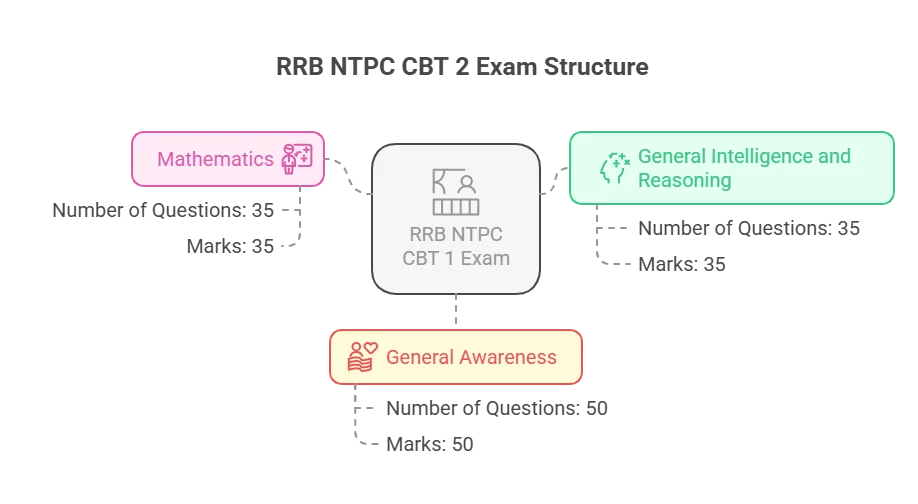
Core Exam Subjects & Syllabus Breakdown
The syllabus spans three main subjects. For foundational practice, check out RRB NTPC GK & GS questions, Current Affairs, and general GK modules.
- General Awareness
- Mathematics
- General Intelligence & Reasoning
Mathematics Syllabus Topics & Weightage
- Number System
- Decimals
- Fractions
- LCM, HCF
- Ratio and Proportions
- Percentage
- Mensuration
- Time and Work
- Time and Distance
- Simple and Compound Interest
- Profit and Loss
- Elementary Algebra
- Geometry and Trigonometry
- Elementary Statistics
| Topics | Questions (CBT 1) | Questions (CBT 2) |
|---|---|---|
| Number System | 3-4 | 4-5 |
| Simplification | 2-3 | 3-4 |
| Decimals & Fractions | 1-2 | 2-3 |
| LCM & HCF | 1-2 | 2-3 |
| Ratio and Proportion | 2-3 | 3-4 |
| Percentage | 2-3 | 3-4 |
| Mensuration | 2-3 | 3-4 |
| Time and Work | 1-2 | 2-3 |
| Time and Distance | 1-2 | 2-3 |
| Simple & Compound Interest | 2-3 | 3-4 |
| Profit and Loss | 2-3 | 3-4 |
| Elementary Algebra | 1-2 | 2-3 |
| Geometry & Trigonometry | 1-2 | 2-3 |
| Elementary Statistics | 1 | 1-2 |
| Data Interpretation (DI) | 1 | 2-3 |
General Intelligence & Reasoning Syllabus Topics & Weightage
- Analogies
- Completion of Number and Alphabetical Series
- Coding and Decoding
- Mathematical Operations
- Similarities and Differences
- Relationships
- Analytical Reasoning
- Syllogism
- Jumbling
- Venn Diagrams
- Puzzle
- Data Sufficiency
- Statement- Conclusion, Statement- Courses of Action
- Decision Making
- Maps
- Interpretation of Graphs
| Topics | Questions (CBT 1) | Questions (CBT 2) |
|---|---|---|
| Analogies | 3-4 | 4-5 |
| Number & Alphabet Series | 2-3 | 3-4 |
| Coding-Decoding | 3-4 | 4-5 |
| Mathematical Operations | 2-3 | 3-4 |
| Similarities & Differences | 1-2 | 2-3 |
| Relationships (Blood Relations) | 1-2 | 2-3 |
| Analytical Reasoning | 2-3 | 3-4 |
| Syllogism | 1-2 | 2-3 |
| Jumbling | 1 | 1-2 |
| Venn Diagrams | 1-2 | 2-3 |
| Puzzle | 2-3 | 3-4 |
| Data Sufficiency | 1 | 1-2 |
| Statement-Conclusion | 1-2 | 2-3 |
| Decision Making | 1 | 1-2 |
| Maps & Interpretation of Graphs | 1 | 1-2 |
General Awareness Syllabus Topics & Weightage
General Science and Life Science syllabus is up to 10th CBSE level. General Awareness contains 40 questions in CBT 1 and 50 questions in CBT 2.
- Current Events of National and International Importance (Current Affairs)
- Games and Sports
- Art and Culture of India
- Indian Literature
- Monuments and Places of India
- General Science and Life Science (up to 10th CBSE)
- History of India and Freedom Struggle
- Physical, Social and Economic Geography of India and the World
- Indian Polity and Governance- constitution and political system
- General Scientific and Technological Developments, including the Space and Nuclear Program of India
- UN and Other Important World Organizations
- Environmental Issues Concerning India and the World at Large
- Basics of Computers and Computer Applications
- Common Abbreviations
- Transport Systems in India
- Indian Economy
- Famous Personalities of India and the World
- Flagship Government Programs
- Flora and Fauna of India
- Important Government and Public Sector Organisations of India
- Current GK
| Topics | Questions (CBT 1) | Questions (CBT 2) |
|---|---|---|
| Current Events (National & International) | 10-12 | 12-15 |
| History of India | 5-6 | 6-8 |
| Geography (India & World) | 3-4 | 4-5 |
| Indian Polity & Governance | 2-3 | 3-4 |
| Indian Economy | 2-3 | 3-4 |
| General Science (Physics, Chemistry, Biology) | 7-8 | 8-10 |
| Art & Culture of India | 1-2 | 2-3 |
| Indian Literature | 1 | 1-2 |
| Monuments & Places of India | 1 | 1-2 |
| General Scientific & Technological Developments | 2-3 | 3-4 |
| UN and Other Important World Organizations | 1 | 1-2 |
| Environmental Issues | 1 | 1-2 |
| Basics of Computers & Applications | 2-3 | 3-4 |
| Famous Personalities | 1-2 | 2-3 |
| Static GK (various topics) | 5-7 | 7-9 |
Special Tests: CBAT and Typing Skill Test (TST)
Depending on the specific post applied for, candidates may need to clear additional qualifying tests:
- CBAT: Required for Station Master and Traffic Assistant roles after CBT 2, requiring a minimum T-score of 42 (not factored into final merit).
- Typing Skill Test (TST): A qualifying test for clerical roles, requiring a minimum speed of 30 w.p.m. in English or 25 w.p.m. in Hindi.
Preparation Plan after Reviewing Syllabus
To structure your studies effectively, incorporate these RRB NTPC Preparation Tips into your daily routine:
- Plan a preparation study plan and follow it throughout the period to make sure you cover all the topics on time.
- Select the right online classes and study material.
- Understand the exam pattern with the right approach and prepare for the subject you are weak in first.
- Attempt mock tests and previous years' papers regularly to analyse your preparation.
- Keep yourself healthy and hydrated.
After reviewing your mock test scores and syllabus progress, ensure you download your admit cards on time, track examination schedules closely, and organize your travel arrangements well in advance of test day.
Frequently Asked Questions (FAQs)
Recommended Reads
- RRB NTPC 2026 Recruitment: Dates, Vacancies, Syllabus & Exam Pattern
- RRB Section Controller Application Status 2026: Check CEN 03/2026 Status
- RRB Group D Admit Card 2026 Released: Direct Link, Exam Dates & Timings
- RRB Group D Exam Analysis 2026: Shift Timings, Difficulty & Good Attempts
- RRB Group D Official Mock Test 2026 Activated: Check CBT Exam Pattern & Direct Link
- RRB Isolated Categories Answer Key 2026 Out: Download CBT Response Sheet & Raise Objections
Negative Marking & Net Score Calculator
Calculate your exact post-answer-key net marks after deducting 1/3rd or 1/4th negative penalty across SSC, UPSC, and State exams.
Never miss another exam update!
Get the fastest exam results, recruitment news, and educational guides delivered directly to your phone.