The Madhya Pradesh Employee Selection Board (MP ESB) has officially released the MP TET Varg 2 Syllabus and Exam Pattern for the 2026 recruitment cycle. This comprehensive testing framework governs selections for Secondary Teachers, Primary Teachers, and specialized instructors across the School Education Department and Tribal Affairs Department. Candidates aspiring to secure these positions must acquaint themselves thoroughly with the prescribed curriculum, exam structure, and evaluation guidelines.
Overview of MP TET Varg 2 Teacher Selection Test 2026
The curriculum is structured around the Madhya Pradesh state board syllabus for classes 9 to 12, with an advanced complexity set strictly at the graduate level. To assist candidates in tracking all key elements, the essential parameters of the assessment are outlined below.
| Organisation Name | Madhya Pradesh Employee Selection Board (MP ESB) |
| Exam Name | MP TET Varg 2 Teacher Selection Test 2026 |
| Category | Syllabus |
| Mode of Exam | Online |
| Duration | 2 hours |
| Number of Questions | 100 marks |
| Marking Scheme | 1 Mark for correct Attempt No negative marking |
| Selection Process | Written Exam |
| Official Website | http://www.esb.mp.gov.in/ |
MP TET Varg 2 Selection Process Stages
Securing a teaching position requires successful navigation through multiple consecutive evaluation phases:
- Written Examination
- Counseling
- Document Verification
MP TET Varg 2 Subjects Covered
Aspirants can choose or test across various core educational disciplines. The core areas covered include:
- Hindi
- English
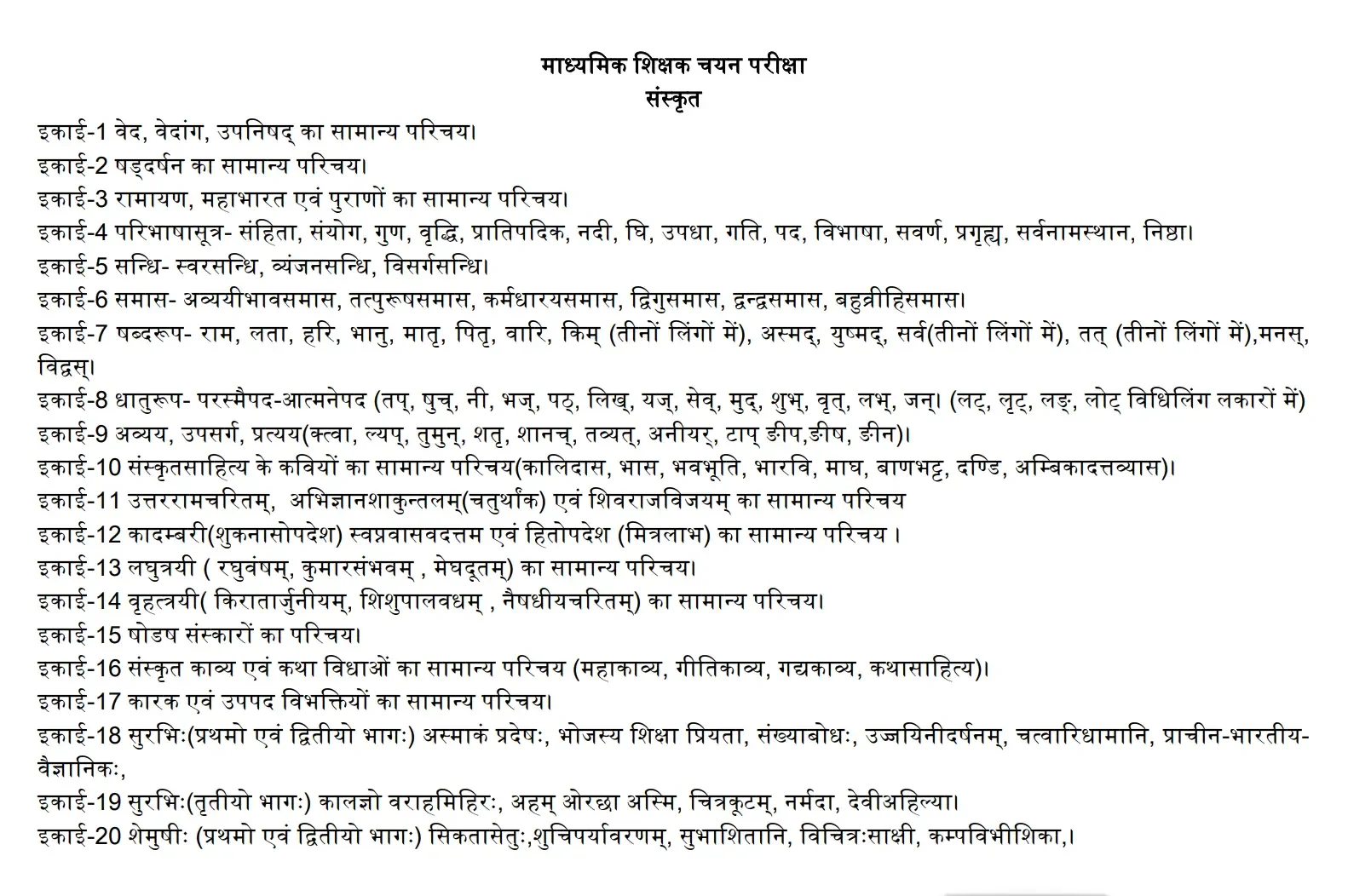
- Sanskrit
- Mathematics
- Science
- Social Science
MP TET Varg 2 Exam Pattern 2026
The online test format is designed to evaluate candidates uniformly across all subject areas under strict time constraints. Review the pattern structure below:
| Subjects | No. of Questions | Total Marks | Duration |
|---|---|---|---|
| Hindi | 100 | 100 | 2 hours |
| English | 100 | 100 | 2 hours |
| Sanskrit | 100 | 100 | 2 hours |
| Mathematics | 100 | 100 | 2 hours |
| Science | 100 | 100 | 2 hours |
| Social Science | 100 | 100 | 2 hours |
Detailed Subject-Wise Syllabus Breakdown
To prepare effectively, candidates should dive deep into the specific sub-topics and unit breakdowns prescribed for each individual discipline.
MP TET Varg 2 Syllabus for Hindi
| Units | Topics |
|---|---|
| Unit 1 | History of Hindi: Ancient and Modern Indian languages like Pali, Prakrit, Shauraseni, Magadhi, Apabhramsa, etc. Geographic spread of Hindi and its dialects like Eastern Hindi, Rajasthani, Pahari, etc. Characteristics of Khadi Boli, Braj, and Awadhi. |
| Unit 2 | Various forms of Hindi: Dialects, Standard Hindi, Official Language, Communication in Hindi. Devanagari script: Characteristics and standardization. Hindi Alphabet: Vowels, consonants, and their placement. |
| Unit 3 | History of Hindi literature: Different periods (Adikal, Bhakti Kal, Reetikal, Modern era). Prominent authors and their works. |
| Unit 4 | Development of major (story, essay, drama, poetry, critique) and minor genres (biography, memoir, letter writing, etc.) Important writers and their works. |
| Unit 5 | Poetic forms and literary devices: Rasa, Chhand (Doha, Chaupai, Soratha, etc.), Alankar (Metaphor, Simile, etc.), and word formation rules. |
| Unit 6 | Word classes: Nouns, Pronouns, Verbs, Adjectives, etc. Sentence structure: Parts of speech and syntax. |
| Unit 7 | Word formation: Derivational and inflectional. Vocabulary based on origin (Hindi, foreign, mixed). |
| Unit 8 | Sentence types and structure. Idioms, proverbs, and expressions. |
| Unit 9 | Study of notable works of Hindi writers like Premchand, Surdas, Kabir, Mahadevi Verma, and others. Analysis of poems, stories, essays, and plays from various periods in Hindi literature. |
MP TET Varg 2 Syllabus for English
| Subjects | Topics |
|---|---|
| Reading | Unseen prose passage (Factual, descriptive, or literary) to test comprehension, Interpretation, Inference, Vocabulary Unseen poetry passage (to assess comprehension, interpretation, inference, and vocabulary) |
| Grammar | Nouns Pronouns Prepositions Conjunctions Verbs Adverbs Adjectives Determiners Articles Degree |
| Unit 4 | Tenses, Subject-Verb Agreement, Sentence transformation (active to passive, direct to indirect, negative, interrogative), Punctuation. |
| Unit 5 | Compound and Complex sentences; clauses (Noun, Adjective, Adverb). |
| Unit 6 | Vocabulary: Synonyms, Antonyms, One-word substitution, Idioms, Phrases, Homophones, Homonyms, Homographs, Prefixes |
| Unit 7 | Figures of Speech: Simile, Metaphor, Personification, Paradox, Irony, Alliteration, Hyperbole, Assonance. |
| Unit 8 | Poetry Forms: Sonnet, Ode, Elegy, Satire, Blank Verse; Stanza forms, Syllable division, Rhyme scheme. |
| Unit 9 | Literature (Class IX & X SCERT MP): Class IX: The Fun They Had, The Sound of Music, The Little Girl, A Truly Beautiful Mind, The Snake and Mirror, My Childhood, Reach for the Top, If I Were You. A Letter to God, Nelson Mandela: Long Walk to Freedom, From the Diary of Anne Frank, Mijbil the Otter, Madam Rides the Bus, The Proposal, Glimpses of India. The Lost Child, The Happy Prince, Iswaran the Storyteller, A Tiger in the Zoo, The Ball Poem, Amanda, etc. Themes, characters, and vocabulary in context will be tested. |
| Unit 10 | Poetry: Works by John Keats, Toru Dutt, W.B. Yeats, Sarojini Naidu, Guru Nanak Dev. |
| Unit 11 | Prose: William Hazlitt, A.G. Gardiner, Francis Bacon. |
| Unit 12 | Fiction: Charles Dickens (David Copperfield), Virginia Woolf (Mrs. Dalloway). |
| Unit 13 | Drama: William Shakespeare (The Merchant of Venice), John Galsworthy (The Silver Box). |
| Unit 14 | Short Stories: R.K. Narayan, Ruskin Bond, Rabindranath Tagore. |
| Unit 15 | History of Indian Writing in English (Famous authors and their works). |
MP TET Varg 2 Syllabus for Maths
| Units | Topics |
|---|---|
| Unit 1 | Number Systems & Real Numbers Covers irrational numbers, real numbers, operations on them, Euclid's Division Lemma, and the Fundamental Theorem of Arithmetic. |
| Unit 2 | Polynomials & Linear Equations Focuses on polynomials, zeros, factorization, and linear equations in two variables. Includes quadratic equations and their solutions. |
| Unit 3 | Geometry Includes angles, triangles, quadrilaterals, circles, and properties related to angles and areas. |
| Unit 4 | Area & Volume Covers Heron’s formula, areas related to circles, surface areas, and volumes of solids like cubes, cylinders, and spheres. |
| Unit 5 | Trigonometry Focuses on trigonometric ratios, identities, and applications like heights and distances. |
| Unit 6 | Complex Numbers & Sequences Covers complex numbers, algebra, sequences, and series like arithmetic and geometric progressions. |
| Unit 7 | Coordinate Geometry Includes both 2D and 3D coordinate geometry, distance formula, and vector algebra. |
| Unit 8 | Statistics & Probability Deals with data collection, measures of central tendency, dispersion, and probability theory. |
| Unit 9 | Calculus Covers limits, derivatives, integrals, and applications like maxima and minima, and differential equations. |
| Unit 10 | Vector Analysis & Geometry Focuses on vector products, differential equations, and advanced vector integration theorems like Gauss, Green, and Stoke. |
MP TET Varg 2 Teacher Syllabus for Science
| Classification of living organisms into five kingdoms, including Monera, Protista, Fungi, and Viruses. Plant kingdom classification and plant cycles. |
| Morphology of flowering plants, root, stem, leaf, and modifications. Study of plant families and tissue systems in monocots and dicots. |
| Photosynthesis, respiration, and plant growth. Sexual reproduction in plants, pollination, fertilization, and seed development. |
| Classification of animals, structural organization in earthworm, cockroach, frog, and humans. Study of circulatory, excretory, and digestive systems. |
| Locomotion, muscle types, and movements. Nervous system, reflex actions, brain functions, and endocrine system. |
| Human reproduction, gametogenesis, fertilization, and reproductive health. Methods of birth control and assisted reproductive technologies. |
| Cell structure and functions, including organelles and cell division. Study of plant and animal tissues, biomolecules, and enzymes |
| Heredity, Mendelian inheritance, DNA structure, genetic disorders, and the theory of evolution. |
| Environmental issues, pollution, biodiversity, conservation, and sustainable agricultural practices. |
| Biotechnology applications in health and agriculture, human diseases, and reproductive health awareness. |
| Study of force, motion, laws of motion, momentum, friction, work, energy, power, and gravitation. Includes equations of motion and the law of conservation of energy. |
| Properties of matter, including elasticity, pressure, buoyancy, viscosity, and surface tension. Covers temperature, heat, conduction, and thermodynamics. |
| Magnetism and electricity, including electric charges, fields, Ohm's law, circuits, and magnetism. Focuses on magnetic effects of electric current and electromagnetic induction. |
| Optics and sound, including reflection, refraction, lenses, light dispersion, interference, and sound waves. Covers Doppler effect and the properties of light. |
| Dual nature of light, semiconductors, diodes, LED, laser, and the photoelectric effect. Introduction to Einstein's photoelectric equation and de-Broglie wavelength |
| States of matter, ideal gases, Dalton's law, kinetic theory, and thermodynamics. Includes Gibbs free energy and the behavior of real gases. |
| Periodic table, properties of elements, and types of chemical bonds (ionic, covalent, coordinate). Focus on the electronic configuration of elements. |
| Solutions and equilibrium, types of solutions, chemical equilibrium, and Le Chatelier's principle. Includes ionic equilibrium and pH concepts. |
| Organic chemistry, covering hydrocarbons, functional groups, polymers, and biomolecules. |
MP TET Varg 2 Syllabus for Social Science
| Units | Topics |
|---|---|
| Unit 1 | Political theory: Meaning, definition, importance, political philosophy, and ideologies. Concept of State: Definition, elements, and theories of origin. |
| Unit 2 | Basic political concepts: Freedom, equality, social justice, and rights. Democracy and diversity: Meaning, features, harmony, and conflicts. |
| Unit 3 | Constitution of India: Formation, features, rights, duties, and amendments. Central and State Legislature: Parliament, functions, legislative process, and federalism. |
| Unit 4 | Executive: President, Prime Minister, Council of Ministers (Central and State). Judiciary: Supreme Court, High Court, powers, and jurisdiction. Local Government: Constitutional amendments and human rights commissions. |
| Unit 5 | Elections: Election Commission, process, reforms, and women’s role. Political parties, pressure groups, and regional cooperation. Five-year plans and NITI Aayog. |
| Unit 6 | India's size, location, and physical features: Mountains, plains, plateaus, deserts, and islands. |
| Unit 7 | Drainage systems: Major rivers and basins. Climate: Monsoon, seasons, rainfall distribution. |
| Unit 8 | Natural vegetation, wildlife conservation, population distribution, and census data. Population growth, literacy, health, and National Population Policy. |
| Unit 9 | Resources: Land use, soil conservation, water management, agriculture, and mineral resources. Environmental conservation and energy resources. |
| Unit 10 | Manufacturing industries: Types, importance, and environmental impact. |
| Unit 11 | Prehistoric age, sources of ancient Indian history, and early cultures. Harappan civilization and early human life. |
| Unit 12 | Religious, cultural, and philosophical developments: Vedic Era, Buddhism, Jainism. Ancient Indian dynasties and the rise of Rajputs. |
| Unit 13 | Medieval history: Delhi Sultanate, Mughal Empire, and Maratha rise. Religious mechanisms: Bhakti, Sufi, Sikhism. |
| Unit 14 | British arrival, establishment of British rule, and Indian Renaissance. Indian National Movement: Struggles, revolts, and independence. |
| Unit 15 | Major European and world events: French Revolution, unifications of Germany and Italy Russian Revolution, World Wars, and Globalization. |
Next Steps & Essential Resources
After reviewing the syllabus details, candidates should prepare their study schedule and monitor upcoming announcements regarding admit card releases and exam center details. To enhance preparation quality, review previous year question trends, organize travel arrangements in advance of test day, and examine official documents closely.
Download MP TET Varg 2 Syllabus PDF
MP TET Varg 2 Previous Year Question Papers - Click to Check
For additional official news and updates, visit the http://www.esb.mp.gov.in/ portal.
Frequently Asked Questions (FAQs)
Recommended Reads
- MP Varg 2 Result 2025 Out: Check MSTST & PSTST Scorecards
- MP TET Varg 3 Revised Result 2026 Out: Download Scorecard & Merit List
- RSSB Computer Instructor Question Paper 2026 PDFs: Download BCI & SCI Papers
- MPESB Group-2 Sub Group 4 Patwari Recruitment 2026: Check 200 Vacancies, Dates & Apply Online
- MP Patwari Salary 2026: Pay Scale, Basic Pay, Allowances & Job Profile
- MPSC Meghalaya LDA Admit Card 2026 Out - Download Hall Ticket
Negative Marking & Net Score Calculator
Calculate your exact post-answer-key net marks after deducting 1/3rd or 1/4th negative penalty across SSC, UPSC, and State exams.
Never miss another exam update!
Get the fastest exam results, recruitment news, and educational guides delivered directly to your phone.