Mensuration stands as a core branch of mathematics focused heavily on geometric properties and their exact measurements, such as length, area, volume, and surface area. Whether you are navigating school mathematics in Class 8, 9, and 10 or gearing up for prominent competitive exams like SSC CGL, SSC CHSL, SSC MTS, SSC CPO, Delhi Police Constable, and Bank Exams, mastering these calculations is vital.
Core Concepts: 2D versus 3D Geometric Figures
Understanding space requires drawing a clear line between two-dimensional and three-dimensional objects. 2D shapes feature only 2 dimensions (length and breadth), remain entirely flat without depth, and cannot be held physically. Conversely, 3D shapes introduce a third dimension (height), incorporate depth, and can be physically handled.
| 2-Dimensional Figures | 3-Dimensional Figures |
|---|---|
| As the name suggests, a 2D shape means that it will have only 2 dimensions which are length and breadth. | Here, a 3D shape means that this figure will have 3 dimensions, which are length, breadth, and height. |
| For 2D shapes, we can calculate 2 things i.e. area and perimeter. | For 3D shapes, we can calculate their volume, total surface area, and curved/lateral surface area. |
| 2D shapes are flat as they do not have depth and also, these cannot be held physically because of the lack of depth. | 3D shapes contain a depth so they can be held physically and are not flat like 2D shapes. |
| Example: Square, Rectangle, Triangle, Circle, etc. | Example: Cone, Cylinder, Sphere, Cube, Prism, Pyramid, etc. |
Important Terms Related to Mensuration Formula
Before diving into formulas, keep these essential terms handy:
- Perimeter: The total length of the boundary of a closed figure, measured in linear units like meters (m) or centimeters (cm).
- Area: The measure of the surface enclosed within a 2D boundary, expressed in square units (m², cm²).
- Volume: The total space occupied by a 3D object, measured in cubic units (m³, cm³).
- Curved/Lateral Surface area: The area of the side surfaces of a 3D figure, excluding the base and top, measured in square units.
- Total Surface area: The combined area of all surfaces of a 3D object, including the top, bottom, and lateral sides.
Mensuration Formulas for 2-Dimensional Figures
Areas of 2D figures are calculated in square units, while perimeters rely on linear units. Note that the value of π is typically 22/7 or 3.14.
| Shape | Area | Perimeter |
|---|---|---|
| Circle | πr² | 2 π r |
| Square | (side)² | 4 × side |
| Rectangle | length × breadth | 2 (length + breadth) |
| Scalene Triangle | √[s(s−a)(s−b)(s−c)], Where, s = (a+b+c)/2 |
a+b+c (sum of sides) |
| Isosceles Triangle | ½ × base × height | 2a + b (sum of sides) |
| Equilateral Triangle | (√3/4) × (side)² | 3 × side |
| Right Angled Triangle | ½ × base × hypotenuse | A + B + hypotenuse, where the hypotenuse is √A²+B² |
| Parallelogram | base × height | 2(l+b) |
| Rhombus | ½ × diagonal1 × diagonal2 | 4 × side |
| Trapezium | ½ h(sum of parallel sides) | a+b+c+d (sum of all sides) |
For deeper study on specific properties, you can reference resources covering the Equilateral Triangle Formula.

Mensuration Formulas for 3-Dimensional Figures
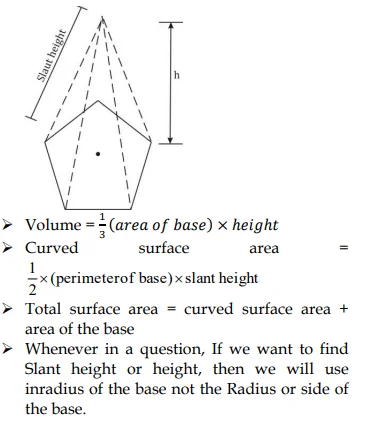
When dealing with 3D objects, total surface area represents the sum of the curved (lateral) surface area and the areas of the top and bottom bases. Surface areas are expressed in square units, whereas volume uses cubic units.
| Shape | Area | Curved Surface Area (CSA)/ Lateral Surface Area (LSA) | Total Surface Area (TSA) |
|---|---|---|---|
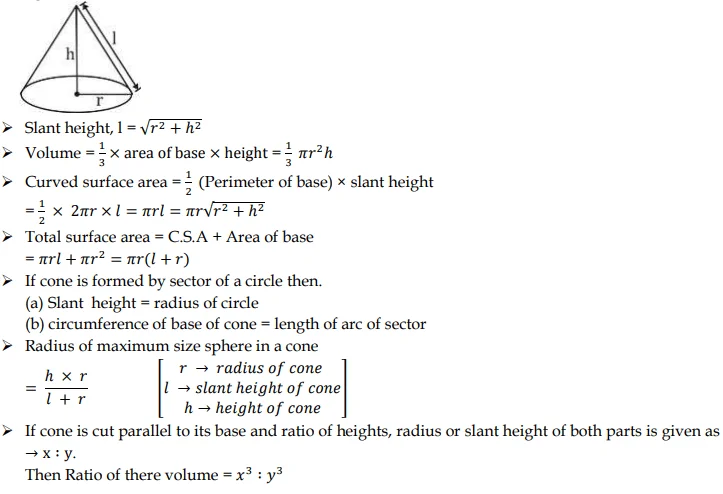
| Cone | (1/3) π r² h | π r l | πr (r + l) |
| Cube | (side)³ | 4 (side)² | 6 (side)² |
| Cuboid | length × breadth × height | 2 height (length + breadth) | 2 (lb +bh +hl) |
| Cylinder | π r² h | 2π r h | 2πrh + 2πr² |
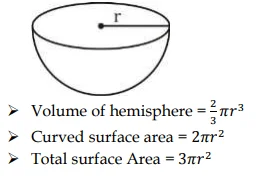
| Hemisphere | (2/3) π r³ | 2 π r² | 3 π r² |
| Sphere | 4/3πr³ | 4πr² | 4πr² |
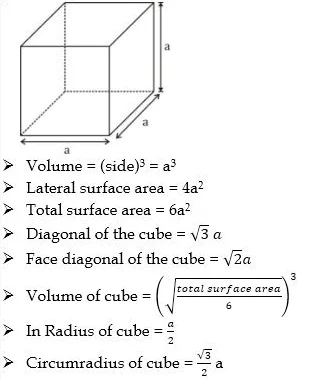
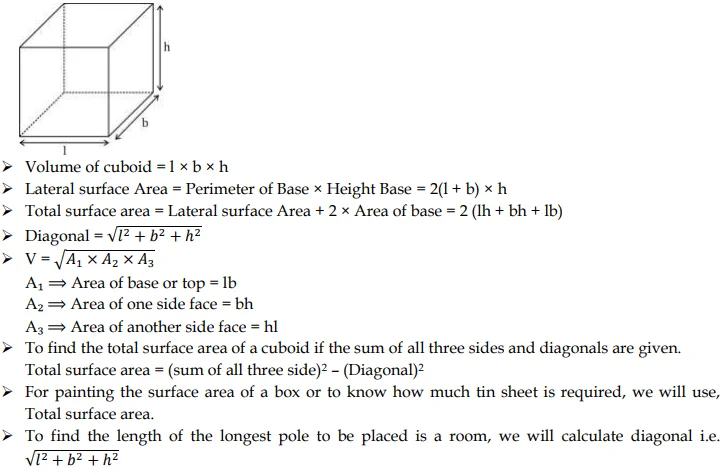
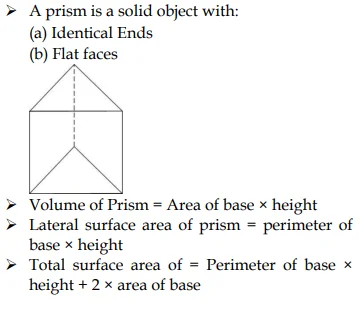
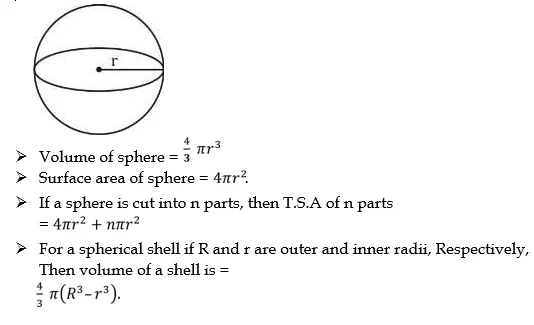
Download Mensuration Formulas PDFs
To assist with offline study and quick revisions before your exams, you can download the reference sheets directly:
After downloading your reference material, organize your study schedule, practice sample mock questions regularly, and ensure you review your admit cards and exam timelines well ahead of your test dates.
Frequently Asked Questions (FAQs)
Recommended Reads
- AIIMS NORCET 11 Prelims Exam City 2026: Release Date, Steps & Details
- AP TET Response Sheet & Initial Answer Key 2026 Released: Check Scores & Raise Objections
- Bank of Baroda LBO Previous Year Papers: Benefits & Strategy
- BPSC TRE 4.0 2026: Major Changes, Exam Pattern, and Vacancy Details
- CPCB Recruitment 2026: Apply for 51 Contractual Posts Under SER Phase III
- Bank of Baroda LBO Salary 2026: Structure, Allowances & Growth
Exam Photo & Signature Resizer (20KB - 50KB)
Resize passport photo & signature to 20-50KB with Name & Date of Photo (DOP) strip or combine them in 1-click.
Never miss another exam update!
Get the fastest exam results, recruitment news, and educational guides delivered directly to your phone.