List of Indian Prime Ministers
While the President of India serves as the nominal head of state, the Prime Minister of India acts as the head of government and the primary executive authority. Appointed by the president of India, the Prime Minister is the leader of the party or coalition that secures a majority in the Lok Sabha (the Lower House of Parliament). Below is the chronological list of the prime ministers in the table below, from the earliest to the most recent.
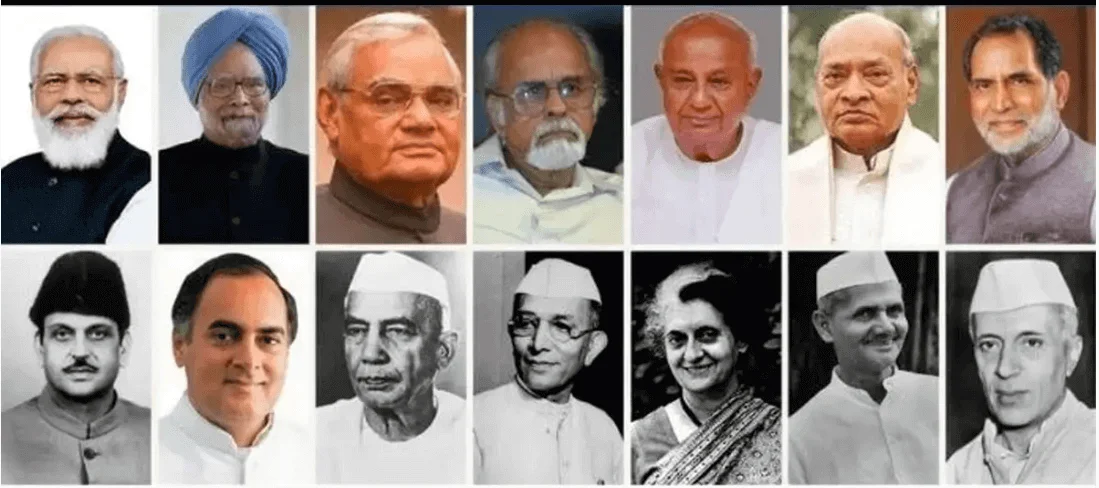
Prime Minister of India List 1947 to 2026
Jawaharlal Nehru became the first Prime Minister of India on August 15, 1947. Today, Narendra Modi serves as the current Prime Minister, having secured a historic third consecutive term in office. Please refer to the comprehensive table below for the complete list of Indian Prime Ministers from 1947 to 2026.
| Prime Minister of India from 1947 to 2026 | |
| Prime Minister Name | Period |
| Jawahar Lal Nehru | 15 Aug 1947 to 27 May 1964 |
| Gulzarilal Nanda | 27 May 1964 to 9 June 1964 |
| Lal Bahadur Shastri | 09-Jun-1964 to 11-Jan-1966 |
| Gulzarilal Nanda | 11 January 1966 to 24 January 1966 |
| Indira Gandhi | 24-Jan-1966 to 24-Mar-1977 |
| Morarji Desai | 24-Mar-1977 to 28-Jul-1979 |
| Charan Singh | 28-Jul-1979 to 14-Jan-1980 |
| Indira Gandhi | 14-Jan-1980 to 31-Oct-1984 |
| Rajiv Gandhi | 31-Oct-1984 to 02-Dec-1989 |
| Vishwanath Pratap Singh | 02-Dec-1989 to 10-Nov-1990 |
| Chandra Shekhar | 10-Nov-1990 to 21-Jun-1991 |
| P. V. Narasimha Rao | 21-Jun-1991 to 16-May-1996 |
| Atal Bihari Vajpayee | 16-May-1996 to 01-Jun-1996 |
| H. D. Deve Gowda | 01-Jun-1996 to 21-Apr-1997 |
| Atal Bihari Vajpayee | 19-Mar-1998 to 22-May-2004 |
| Dr. Manmohan Singh | 22-May-2004 to 26-May-2014 |
| Narendra Damodardas Modi | 26-May-2014 to Incumbent |
Import Points Related to Indian Prime Ministers
The Prime Minister of India holds the most significant executive power within the Indian political system. Below are essential facts and highlights regarding the office of the Prime Minister, often featured in competitive exams.
- Jawaharlal Nehru was the first prime minister of India. He is also India's longest-serving prime minister.
- Indira Gandhi was the first woman prime minister of India.
- Rajiv Gandhi was sworn in as India's youngest prime minister.
- Manmohan Singh is the first Sikh prime minister of India.
- Narendra Damodardas Modi is the current Prime Minister of India (14th), and he is serving his third term.
List of All Prime Ministers of India
Narendra Damodardas Modi (2014-Incumbent)
Narendra Modi, the head of the Government of India, serves as the leader of the Lok Sabha and chairs the Council of Ministers. As the 14th Prime Minister of India, he is currently in his third term, having first assumed office in 2014 following the 16th Lok Sabha elections. Review the historical list of his predecessors below.
Manmohan Singh (2004-2014)
Dr. Manmohan Singh, India's 13th Prime Minister, served two full terms as the leader of the United Progressive Alliance (UPA). An experienced parliamentarian and former leader of the Rajya Sabha, he is widely credited for spearheading the 1991 LPG (Liberalisation, Privatisation, Globalisation) reforms as Finance Minister. Additionally, he served as the 15th governor of the Reserve Bank of India and is a 1987 Padma Vibhushan recipient.
Atal Bihari Vajpayee (1996, 1998-99, 1999-2004)
Atal Bihari Vajpayee, a statesman who served three terms as Prime Minister, is remembered for his dedication to governance. Awarded the Bharat Ratna in 2014, he famously coined the slogan "Jai Jawan, Jai Kisaan, Jai Vigyan". A founding figure of the Bharatiya Janata Party and a 10-time Lok Sabha member, his tenure oversaw the landmark Pokhran-II nuclear tests in 1998. His birthday, December 25, is celebrated annually as Good Governance Day.
Inder Kumar Gujral (1997-1998)
I. K. Gujral, the 12th Prime Minister, was a veteran of the Quit India Movement. Known for his diplomatic acumen, he formulated the "Gujral Doctrine," a series of foreign policy principles aimed at fostering peaceful relations with India's immediate neighbors, including Pakistan.
HD Deve Gowda (1996-1997)
H. D. Deve Gowda served as the 11th Prime Minister of India following his tenure as the Chief Minister of Karnataka. He assumed the premiership in 1996 through a coalition government under the United Front banner, later continuing his parliamentary service in the 14th, 15th, and 16th Lok Sabhas.
PV Narasimha Rao (1991-1996)
P. V. Narasimha Rao, the 10th Prime Minister, holds the distinction of being the first PM from Southern India. His administration was transformative, marked by the initiation of major economic reforms in 1991. He brought vast administrative experience to the office, having previously served as Chief Minister of Andhra Pradesh and as a Union Minister for Defence, External Affairs, and Home Affairs.
Chandra Shekhar (1990-1991)
Chandra Shekhar served as the eighth Prime Minister, leading a minority government. His short tenure was defined by the 1991 economic crisis and the tragic assassination of former Prime Minister Rajiv Gandhi, leading his administration to be described by some as a ‘lame duck’ government.
VP Singh (1989-1990)
Vishwanath Pratap Singh, the seventh Prime Minister, previously served as the Chief Minister of Uttar Pradesh. His cabinet tenure as Defence Minister was marked by the Bofors scandal, and his term as PM is most noted for the implementation of the Mandal Commission Report, which expanded reservation quotas in government sectors.
Rajiv Gandhi (1984-89)
Rajiv Gandhi, the sixth Prime Minister and son of Indira Gandhi, assumed office in 1984. At age 40, he became the youngest PM of India. A former pilot, his term was defined by events such as the Shah Bano case and the Bhopal gas tragedy. He was assassinated by an LTTE suicide bomber in 1991 and was posthumously awarded the Bharat Ratna.
Chaudhary Charan Singh (1979-80)
Chaudhary Charan Singh was the fifth Prime Minister of India. Born into a farming family in Uttar Pradesh, he was widely regarded as a fierce champion of peasants' rights throughout his political career.
Morarji Desai (1977-79)
Morarji Desai, the fourth Prime Minister of India, led the first non-Congress government. A veteran leader who served as the Chief Minister of the Bombay State, he brought a unique administrative approach to the national government during his tenure under the Janata Party banner.
Indira Gandhi (1966-1977, 1980-1984)
Indira Gandhi, the third Prime Minister and the only woman to hold the office, served one of the longest tenures in Indian history. Her leadership spanned critical events, including the 1971 war with Pakistan, the 1975 state emergency, and Operation Blue Star. She was assassinated in 1984 by her own security detail.
Gulzarilal Nanda (1964, 1966)
Gulzarilal Nanda twice served as the acting Prime Minister of India. He first stepped into the role following the death of Jawaharlal Nehru in 1964 and again in 1966 after the passing of Lal Bahadur Shastri, each time serving for a brief 13-day period.
Lal Bahadur Shastri (1964-1966)
Lal Bahadur Shastri, the second Prime Minister of India, is remembered for his integrity and the iconic slogan ‘Jai Jawan, Jai Kisan’, which galvanized the nation during the 1965 Indo-Pakistan war. He passed away in Tashkent, Uzbekistan, shortly after signing the historic Tashkent Agreement.
Jawaharlal Nehru (1947-1964)
Jawaharlal Nehru was the first and longest-serving Prime Minister of India, guiding the nation through its formative post-independence years. Affectionately known as 'Chacha Nehru' by children and 'Pandit Nehru' due to his Kashmiri Pandit heritage, he remained a central figure in Indian politics until his death in 1964.
List of Presidents of India- Click to Check
Prime Ministers of India List- FAQs
Ans. Narendra Damodardas Modi is the current Prime Minister of India.
Ans. Jawaharlal Nehru remains the longest-serving Prime Minister of India.
Ans. Jawaharlal Nehru was the first Prime Minister of India.
Ans. Indira Gandhi was the first and remains the only woman to have served as Prime Minister of India.
Ans. Rajiv Gandhi holds the record for being the youngest Prime Minister of India.
Ans. The President of India officially appoints the Prime Minister of India.
Also Read:
- Rajasthan BSTC 1st College Allotment List 2026 Released - Check Now
- SBI Clerk 1st Waiting List 2026 Out: Download PDF and Check Selection Status
- UP BEd Merit List 2026 Released: Download JEE Entrance Result PDF
- UP Police Constable Exam City Slip 2026 Out: Check Your Allotted District Now
- DEE Assam Final Merit List 2025 Released at dee.assam.gov.in (LP & UP Teachers) – Check Cut Off
- UP BEd JEE Toppers List 2026: Vandana Singh Secures Rank 1 with 359/400