The Group of Twenty, widely known as the G20, stands as the premier intergovernmental forum for international economic cooperation. Representing the world's major developed and emerging economies, this collective carries immense weight, accounting for approximately 90% of global GDP, 80% of total international trade, and two-thirds of the world's population.
Historical Evolution and Structure
Established in 1999, the G20 initially functioned as a gathering for Finance Ministers and Central Bank Governors to navigate global financial crises. Recognizing the need for high-level political guidance, the forum transitioned to an annual summit of Heads of State in 2008, beginning with the inaugural Washington, D.C. summit. Notably, the G20 operates without a permanent secretariat or physical headquarters, with the presidency rotating annually to ensure regional representation.
G20 Purpose & Objectives
- Policy coordination between members to achieve global economic stability and sustainable growth
- Advancing financial regulations to mitigate risks and prevent future economic instability
- Modernizing the global international financial architecture for current and future challenges
Member Nations
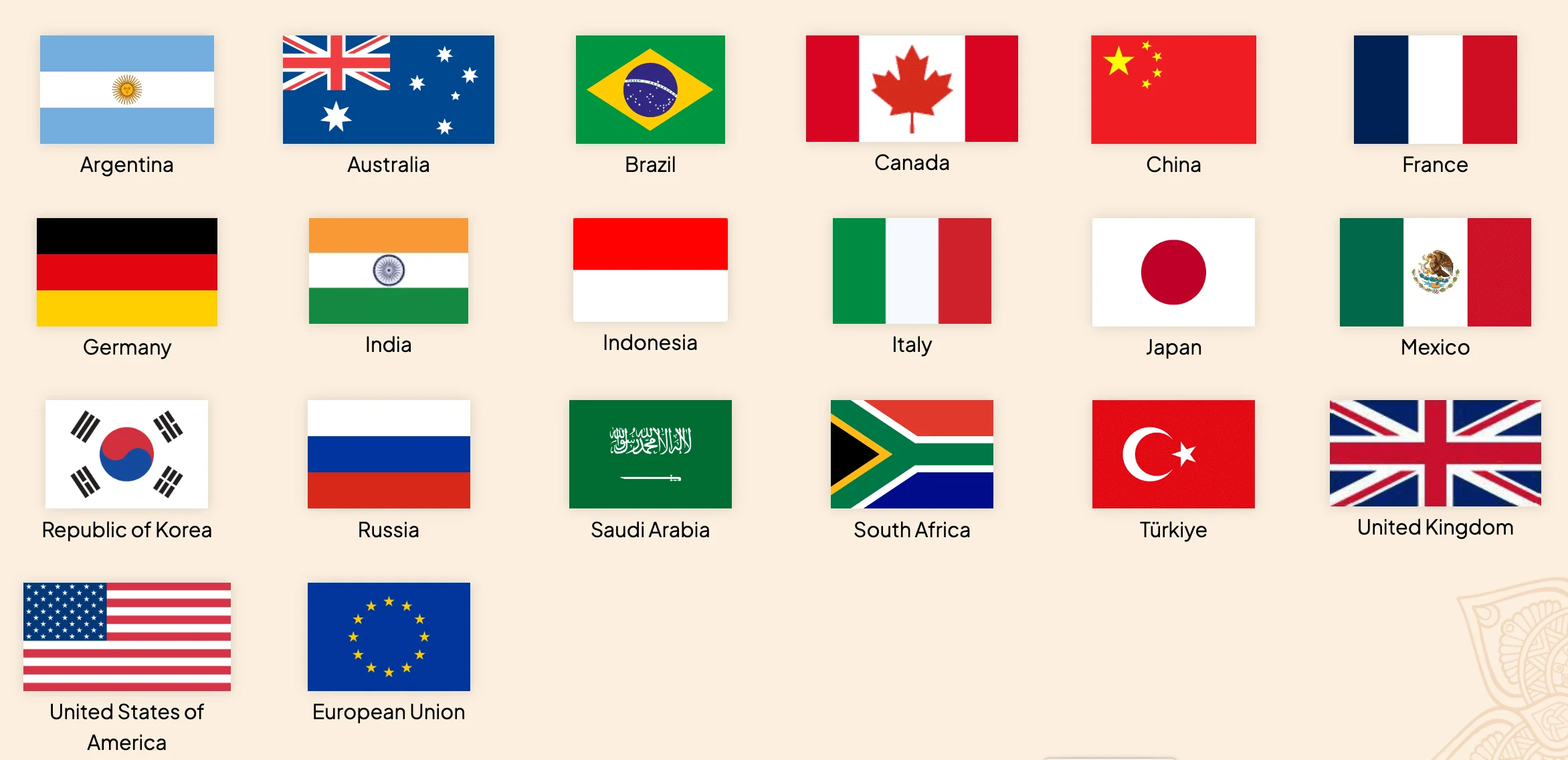
The G20 consists of 19 individual countries and the European Union. These members are strategically chosen to ensure a global balance of power and economic influence.
G20 Member Countries List
- Argentina
- Australia
- Brazil
- Canada
- China
- France
- Germany
- India
- Indonesia
- Italy
- Japan
- Republic of Korea
- Mexico
- Russia
- Saudi Arabia
- South Africa
- Türkiye
- United Kingdom
- United States
- European Union (EU)
G20 Institutional Overview
| Formation | 1999( But G20 Summits began in 2008 to convene annually) |
| Purpose | Policy coordination between its members in order to achieve global economic stability, and sustainable growth; Advancing financial regulations to mitigate risks and prevent future economic instability; Modernizing the global international financial architecture for current and future challenges. |
| Membership | 19 Countries and European Union |
Chronology of G20 Summits
| Year | Hosting Countries | Themes & Details |
|---|---|---|
| 2008 | Washington DC (USA) | The 2008 Summit was the 1st G20 Meeting which focuses on the theme “To prevent future financial crises, global economic governance needs reform to secure sustainable and balanced growth”. |
| 2009 | Pittsburgh (USA) | This summit mandated stricter banking regulations, including increased profit retention for capital building. G20 Summit 2009 has been referred to as the “London Summit”. |
| 2010 | Toronto (Canada) | The theme of the summit held in 2010 in Toronto (Canada) was “Shared Growth Beyond Crisis”. |
| 2011 | Cannes (France) | The 2011 G20 Cannes Summit was the sixth in a series of meetings among heads of government and heads of state of G20 countries to discuss financial markets and the global economy. |
| 2012 | Los Cabos (Mexico) | In 2012, Mexico prioritized economic stability, structural reform for growth and employment, strengthening financial systems, and promoting financial inclusion for economic growth during its G20 Presidency. |
| 2013 | St. Petersburg (Russia) | The G20 Summit held in 2013 focuses on 8 sectors- framework for strong, sustainable and balanced growth; jobs and employment; international financial architecture reform; strengthening financial regulation; energy sustainability; development for all; enhancing multilateral trade; and fighting corruption. |
| 2014 | Brisbane (Australia) | G20 Summit 2014 was held in Brisbane (Australia) with general themes including “global economy, financial regulation, poverty reduction and sustainable development”. |
| 2015 | Antalya (Turkey) | During the 2015 G20 Summit in Antalya, leaders addressed migration and refugee movements and issued a statement on fighting terrorism. |
| 2016 | Hangzhou (China) | The theme of the 2016 Summit China was “Towards an innovative, invigorated, interconnected and inclusive world economy”. |
| 2017 | Hamburg | Theme- “Shaping an interconnected world” |
| 2018 | Buenos Aires | “Building Consensus For Fair And Sustainable Development” |
| 2019 | Osaka (Japan) | The G20 Summit 2019 focused on key issues such as Trade and Investment; Excess Capacity of Steel; Digitalization; Data Free Flow with Trust; G20/OECD Framework on Base Erosion and Profit Sharing; Quality Infrastructure investment; Anti-Corruption; Climate Change; Energy; Environment; Displacement and Migration. |
| 2020 | Saudi Arabia | The theme of G20 Summit 2020 was “Realising Opportunities of the 21st Century for all”. G20 Summit Saudi Arabia 2020 was the first-ever virtual Summit in the history of G20. |
| 2021 | Italy | G20 Italy Summit 2021 focus on three broad, interconnected pillars of action- “People, Planet, Prosperity”. |
| 2022 | Bali, Indonesia | The G20 summit’s theme for the year 2022 was “Recover Together, Recover Stronger”. |
| 2023 | New Delhi (India) | The G20 summit’s theme for the year 2023 is “Vasudhaiva Kutumbakam” or “One Earth, One Family, One Future”. |
Frequently Asked Questions (FAQs)
Recommended Reads
- AIIMS NORCET 11 Prelims Exam City 2026: Release Date, Steps & Details
- AP TET Response Sheet & Initial Answer Key 2026 Released: Check Scores & Raise Objections
- Bank of Baroda LBO Previous Year Papers: Benefits & Strategy
- BPSC TRE 4.0 2026: Major Changes, Exam Pattern, and Vacancy Details
- CPCB Recruitment 2026: Apply for 51 Contractual Posts Under SER Phase III
- Bank of Baroda LBO Salary 2026: Structure, Allowances & Growth
CGPA to Percentage Calculator
Convert your college 10-point CGPA or SGPA to equivalent percentage using official university multiplication formulas.
Never miss another exam update!
Get the fastest exam results, recruitment news, and educational guides delivered directly to your phone.