Calculus is a fundamental pillar of advanced mathematics, and at its core lies differential calculus. Differential calculus principles were originally pioneered by the brilliant mind of Isaac Newton. For students navigating grades 11 and 12, mastering the foundational concepts, definitions, and formulas of differentiation is essential for academic success and advanced problem-solving.
Core Definitions and Concepts in Differentiation
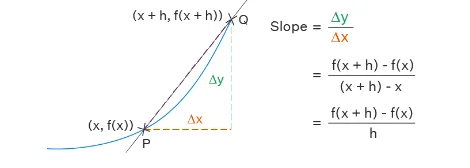
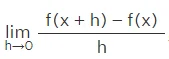
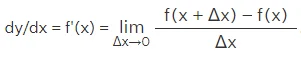
In mathematical terms, differentiation is the specific process used to calculate the derivative of a function. A derivative fundamentally represents the instantaneous rate of change of one function with respect to another. When considering a function denoted as y = f(x), the derivative is typically represented notationally as f'(x) or dy / dx.
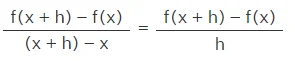
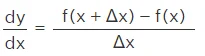
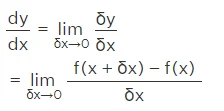
Geometrically, the derivative of y = f(x) translates to the exact slope of the tangent line drawn to the curve at the specific point (x, f(x)). When computing a derivative utilizing limits, this foundational method is referred to as the first principle of differentiation. Furthermore, the derivative operator itself is written as d/dx, also widely known as the differential coefficient or Leibniz notation.
Continuity Versus Differentiability
A crucial theoretical concept for high school students to remember is that if a function is differentiable at a designated point x₀, it is necessarily continuous at that point. However, students should note that the reverse is not always true; a continuous function does not automatically guarantee differentiability everywhere.
Trigonometric Ratios and Higher-Order Derivatives
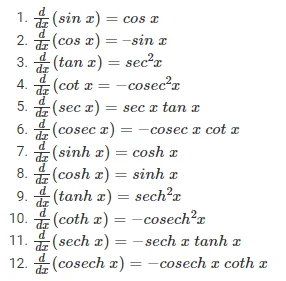
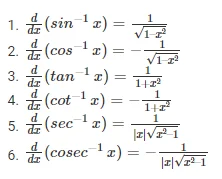
Advanced calculus frequently integrates trigonometry. There are six primary trigonometric ratios: sine, cosine, tangent, cotangent, secant, and cosecant. Additionally, inverse trigonometric functions serve as the mathematical inverses of these standard ratios.
As students progress, they encounter higher-order derivation. In this context, the second derivative is designated as f''(x) or d²y/dx², and the third derivative is written as f'''(x) or d³y/dx³.
Real-World Applications in Physics
Derivatives are not purely abstract symbols; they have powerful real-world applications. In physics, derivatives describe motion: displacement's first derivative yields velocity, the second derivative yields acceleration, and the third derivative yields jerk.
Elementary Functions Differentiation Formulas
Memorizing standard formulas accelerates problem-solving efficiency. Below is the essential checklist for elementary function derivatives:
- Constant function: y = k -> y' = 0
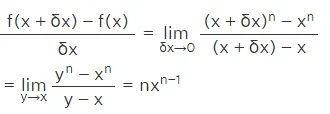
- Power function: y = x^n (n > 0) -> y' = n * x^(n-1)
- Logarithmic function: y = ln x -> y' = 1 / x
- Logarithmic function: y = loga x -> y' = 1 / [(log a) * x]
- Exponential function: y = a^x -> y' = a^x * log a
Rules of Differentiation
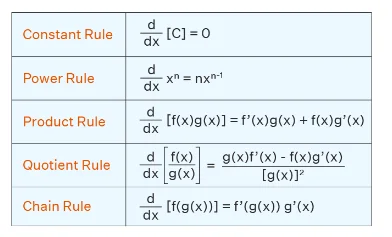
To handle complex functions combining multiple operations, students must rely on standard operational rules. Review the checklist of rules below:
- Sum Rule: If y = u(x) ± v(x), then dy/dx = du/dx ± dv/dx
- Product Rule: If y = u(x) × v(x), then dy/dx = u * (dv/dx) + v * (du/dx)
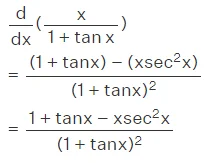
- Quotient Rule: If y = u(x) ÷ v(x), then dy/dx = [v * (du/dx) - u * (dv/dx)] / v²
- Power Rule: If y = x^n, then (d/dx)(x^n) = n * x^(n-1)
- Chain Rule: If y = f(u) and u = g(x), then d/dx(f(g(x))) = f'(g(x)) * g'(x)
- Constant Rule: If y = k * f(x) (k ≠ 0), then d/dx(k * f(x)) = k * d/dx(f(x))
Next Steps for Calculus Students
After reviewing and memorizing these core differentiation formulas, students should immediately test their understanding by solving practice problems spanning polynomial, exponential, and logarithmic functions. Consistency is key when dealing with complex rules like the chain and quotient rules. Furthermore, as you prepare for advanced examinations, make sure to explore complementary mathematical concepts such as the Integration Formula for Class 12th - Click to Check to establish a balanced command over both differential and integral calculus.
Frequently Asked Questions (FAQs)
Recommended Reads
- AIIMS NORCET 11 Prelims Exam City 2026: Release Date, Steps & Details
- AP TET Response Sheet & Initial Answer Key 2026 Released: Check Scores & Raise Objections
- Bank of Baroda LBO Previous Year Papers: Benefits & Strategy
- BPSC TRE 4.0 2026: Major Changes, Exam Pattern, and Vacancy Details
- CPCB Recruitment 2026: Apply for 51 Contractual Posts Under SER Phase III
- Bank of Baroda LBO Salary 2026: Structure, Allowances & Growth
Exam Photo & Signature Resizer (20KB - 50KB)
Resize passport photo & signature to 20-50KB with Name & Date of Photo (DOP) strip or combine them in 1-click.
Never miss another exam update!
Get the fastest exam results, recruitment news, and educational guides delivered directly to your phone.