Geometry forms the backbone of spatial reasoning in mathematics, with triangles serving as the foundational building blocks of more complex polygonal shapes. Among these, the equilateral triangle stands out for its perfect symmetry, structural stability, and unique mathematical properties. Whether you are studying for an upcoming math assessment or refreshing your geometry foundations, understanding how to calculate its area, perimeter, and height is essential.

Defining the Equilateral Triangle and Basic Principles
A triangle is a closed geometric figure defined by three line segments meeting at three vertices to form three angles, with an interior angle sum of 180 degrees. Depending on side lengths and angle measurements, triangles can be classified into several distinct categories:
- Scalene triangle: has no equal sides or angles.
- Isosceles triangle: two sides are equal, as are the opposing angles of equal sides.
- Equilateral triangle: three sides of equal length and three interior angles measuring 60 degrees each.
In an equilateral triangle, every interior angle measures exactly 60 degrees. Furthermore, the median, angle bisector, and altitude coincide for every side, serving as lines of symmetry.
Key Properties of an Equilateral Triangle
Because of its symmetrical nature, an equilateral triangle possesses several unique geometrical traits:
- Perimeter of an equilateral triangle is 3s (or 3a), where 's'/'a' stands for the side length.
- The orthocenter and the centroid of the triangle occupy the exact same point.
- The median, angle bisector, and perpendicular altitude are completely identical.
- Semi-perimeter of an Equilateral Triangle = 3a/2.
- Height of an Equilateral Triangle = √3a/2.
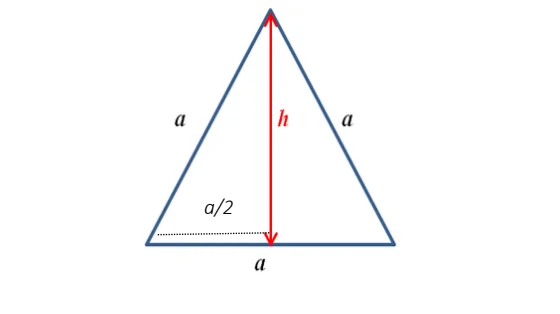
Derivation of Area of the Equilateral Triangle Formula
To fully grasp where the standard area calculation comes from, we can step through its mathematical derivation using fundamental geometric principles and Pythagoras' Theorem (H² = P² + B²). Follow the ordered process below:
- Start with the general formula for the area of a standard triangle: Area of a triangle = 1⁄2 × height (h) × base (a).
- Consider an equilateral triangle with side length 'a' and height 'h', splitting it into a right-angled triangle.
- Apply Pythagoras' Theorem (H² = P² + B²), which yields a² = h² + (a / 2)².
- Rearrange the equation to solve for h²: h² = a² - (a² / 4), which simplifies to h² = (3a² / 4).
- Take the square root to find the height: h = ½ (√3a).
- Substitute the derived value of 'h' back into the general triangle area formula: Area of Triangle = 1⁄2 × ½ (√3a) × a.
- Simplify the expression to arrive at the equilateral triangle area formula: Area of Equilateral Triangle = ¼ (√3a²) or (√3/4)a².
Once you have calculated or derived the area, students and problem solvers should ensure they cross-verify their side lengths, maintain consistent measurement units (such as square centimeters or square meters), and proceed to practice related multi-step geometry problems involving perimeter and semi-perimeter.
Frequently Asked Questions (FAQs)
Recommended Reads
- Mastering Triangle Geometry: Formulas, Calculations, and Classifications
- How to Calculate the Area of a Square: Formulas, Examples, and Geometry Guide
- Mastering the Area of a Parallelogram: Formulas, Properties & Solved Examples
- Understanding Rectangle Properties, Formulas, Area & Calculations
- Mastering the Trapezium: Area, Perimeter, Formulas & Solved Problems
- Mastering Circle Fundamentals, Area Formulas, and Geometry Derivations
Exam Photo & Signature Resizer (20KB - 50KB)
Resize passport photo & signature to 20-50KB with Name & Date of Photo (DOP) strip or combine them in 1-click.
Never miss another exam update!
Get the fastest exam results, recruitment news, and educational guides delivered directly to your phone.